
A Desert Road Trip for Design Lovers: The New Saudi Escape Beyond Riyadh
A design-forward AlUla travel guide for 4–6 days: mirrored architecture, Nabataean heritage, luxe desert stays, and desert-road-trip romance from Riyadh, October–March.
Trip Length
4-6 days
Best Time
October–March
Mood
luxury
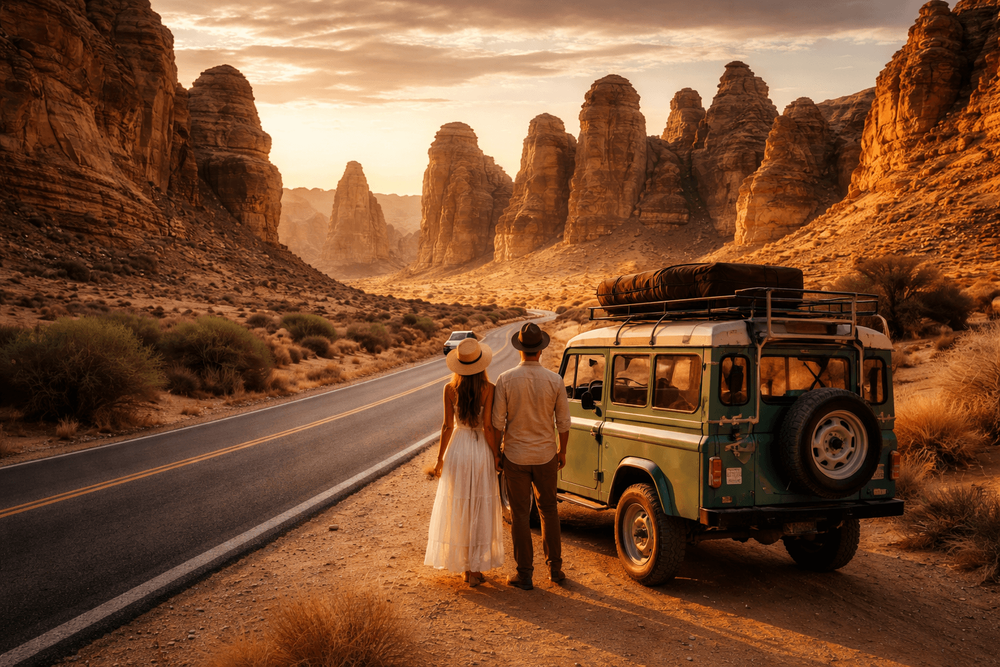
Dawn turns the cliffs of Ashar Valley the color of saffron, and for a moment the desert becomes a gallery—light, rock, and a mirrored façade trading glances as if they’ve known each other for centuries. It’s this union of minimalism and monumentality that sets the tone for an AlUla travel guide: a place where architecture doesn’t shout; it echoes. Arrive by road from Riyadh and the journey itself is part of the design story—long bands of asphalt coursing through volcanic plateaus and date-palm oases, then narrowing into canyons the color of warm clay.
AlUla travel guide: Why this desert is the new design escape
AlUla is having its moment, but not in the way of a typical boomtown. The transformation is measured and curatorially minded. Contemporary structures defer to the land—low-slung villas that pull their palette straight from the sandstone, a jaw-dropping mirrored performance hall that reflects every cloud and cliff, and discreet cultural venues embedded in the valley. Side by side with this modern layer is a world-class archaeological landscape: hand-carved Nabataean tombs at Hegra, ancient Dadan’s sanctuaries, and an open-air archive of inscriptions at Jabal Ikmah.
This is a luxury destination calibrated for design lovers: clean lines against weathered strata, carefully framed views in every direction, and a service culture that’s evolving fast. With four to six days, you can trace the story from deep past to next chapter—without ever losing sight of the desert’s quiet power.
The architecture: mirror, sandstone, and space
For a visceral first hit of contemporary AlUla, head to the mirrored concert hall set in a natural amphitheater of cliffs. Its skin captures the shifting desert sky, turning sunrise and sunset into site-specific installations. Even if you’re not attending a performance, the approach alone is a study in proportion and restraint.
Across the region, new builds lean into materials and forms that belong here: stone-clad pavilions that feel carved rather than constructed; breezeways that funnel desert air; outdoor salons centered on fire bowls and candlelight instead of chandeliers. Designers are thinking in gradients—solid to void, shadow to light—so the architecture acts like a lens rather than a statement piece. In short: the land leads.
Heritage landscapes that feel contemporary
AlUla’s archaeological sites are among the most compelling in the Middle East, and their presentation is increasingly design-forward. Guided visits to Hegra, the Saudi Arabia counterpart to Petra, reveal ornate tomb façades cut into rose-gold rock walls, their crisp lines still sharp against wind-smoothed cliffs. The experience is intentionally paced: you move along defined paths, pausing at key tombs as guides sketch the Nabataean story with the lightest touch.
A short drive away, the ancient city of Dadan shows a different personality—more austere, red-stone temples and a civic layout that hints at an organized, prosperous capital. Nearby Jabal Ikmah functions as an open-air archive, its canyon walls engraved with scripts and symbols that read like messages to the future. The curation at these sites favors clarity over spectacle: discreet signage, shaded rest points, and the kind of quiet that lets inscriptions and reliefs do the talking.
When you want a pure landscape hit, pivot to Elephant Rock (Jabal AlFil). It’s a masterclass in natural sculpture: a freestanding arch that feels purpose-built for golden hour. If time allows, climb to a viewpoint along the black lava fields of the Harrat plateau for an aerial sense of the oasis ribboned below.
Where to stay: luxury in low relief
The new hotel scene here understands context. You’ll find tented-style villas in canyons, stone-and-timber suites tucked into cliffs, and intimate compounds hidden among palms—each designed to feel temporary in spirit, if not in structure. Private terraces are standard, many with plunge pools and outdoor showers, because the ritual in AlUla is to live outside as much as possible. Expect desert-chic minimalism: linen, leather, and hand-hewn wood, plus lighting schemes that choreograph the night sky.
Dining leans experiential. Seasonal chef residencies and pop-up concepts take over terraces and courtyards, so dinner might be a multicourse affair under Orion one night and a modern take on oasis cuisine the next. Don’t come for a scene; come for conversation paced by the pour of mint tea, the scent of acacia on the grill, and a soundtrack of wind through tamarisk.
A 4–6 day design-led itinerary
Use this AlUla travel guide as a blueprint and edit to your pace.
Day 1: Arrival and orientation. Check into your desert base and take the afternoon slow. As light softens, head to the mirrored hall and its surrounding cliffs. You’re here for calibration: scale, silence, and a first impression that resets expectations.
Day 2: Hegra in the morning, when the stone glows and the air is cool. Join an official guided tour to access key tomb clusters and learn the narrative threads. After lunch, walk the Oasis Heritage Trail through palm groves and mud-brick lanes; the geometry of shaded pathways and irrigation channels reveals the oasis as designed landscape. Sunset at Elephant Rock.
Day 3: Dadan and Jabal Ikmah. The pair works as a diptych—civic power and intimate voices—so plan a half-day with a specialist guide. Return to your resort for a late-afternoon hammam or spa ritual, then an alfresco dinner that stretches into stargazing.
Day 4: Contemporary AlUla. Seek out galleries and design exhibitions that surface during the cooler months, or time your trip with performance season to catch a concert backdropped by cliffs. Late afternoon, drive up to a Harrat viewpoint for panoramic photographs. Nightcap around a fire pit with a sky so clear it looks curated.
Day 5–6 (optional): Adventure with a design eye. Sunrise hot-air ballooning runs seasonally and shows the oasis as pattern and texture. A guided hike through sculpted canyons doubles as a masterclass in erosion and time. Consider a desert-drive excursion with a driver who knows the geology; you’ll read the land like an architectural plan.
Getting there and getting around
From Riyadh, you can catch a direct domestic flight to AlUla’s airport; services also operate from other major Saudi cities, with seasonal international flights during peak months. If you prefer the romance of the road, the drive from Riyadh is an all-day traverse through changing desert biomes—plan fuel and rest stops accordingly, and depart before dawn to arrive with light to spare.
On the ground, pre-arranged transfers make life easy, especially if you plan to explore by guided tour. Hiring a private driver is common for site-to-site transfers; self-driving is straightforward on major roads, but some valleys require high-clearance vehicles and local knowledge. Most heritage sites operate on timed or guided access, so build in buffer time between bookings.
What to expect on arrival
AlUla is a modern oasis with a calm rhythm. The airport is compact and efficient, and luggage delivery is typically quick. Many nationalities can apply for a Saudi tourist e-visa; check the latest requirements well before departure. AlUla is alcohol-free, and dress codes lean modest—lightweight, loose layers work best in the desert climate.
Payments are widely cashless, though it’s wise to carry small notes for tips. Connectivity is solid in town and at established resorts; coverage drops as you push deeper into the valleys. Book core experiences—Hegra, Dadan, Jabal Ikmah, and any ballooning or specialty dining—well ahead for visits between October and March. Expect warm days and cool nights, and remember that the most powerful design element here is negative space—leave room in your schedule to do nothing at all.
When to go
The sweet spot for AlUla is October through March. Days are mild enough for long site visits and hikes; nights cool down to perfect fire-pit weather. This is also the primary events season, with performances, exhibitions, and culinary residencies adding a contemporary layer to the heritage core. Summer brings extreme heat and a quieter calendar—fine if your goal is poolside seclusion, but the desert truly performs in winter.
Final notes for design-driven travelers
Think of this AlUla travel guide as permission to slow the frame rate. Let the mirrored hall catch a passing cloud. Linger in the shadow line of a tomb façade. Watch the last light brush a canyon you hiked at dawn. The luxury here isn’t showy; it’s calibrated attention—the feeling that architecture, landscape, and hospitality are in conversation. Pack your curiosity, clear your calendar, and point the car north from Riyadh. The road is long, the palette is warm, and the story is still being written.