
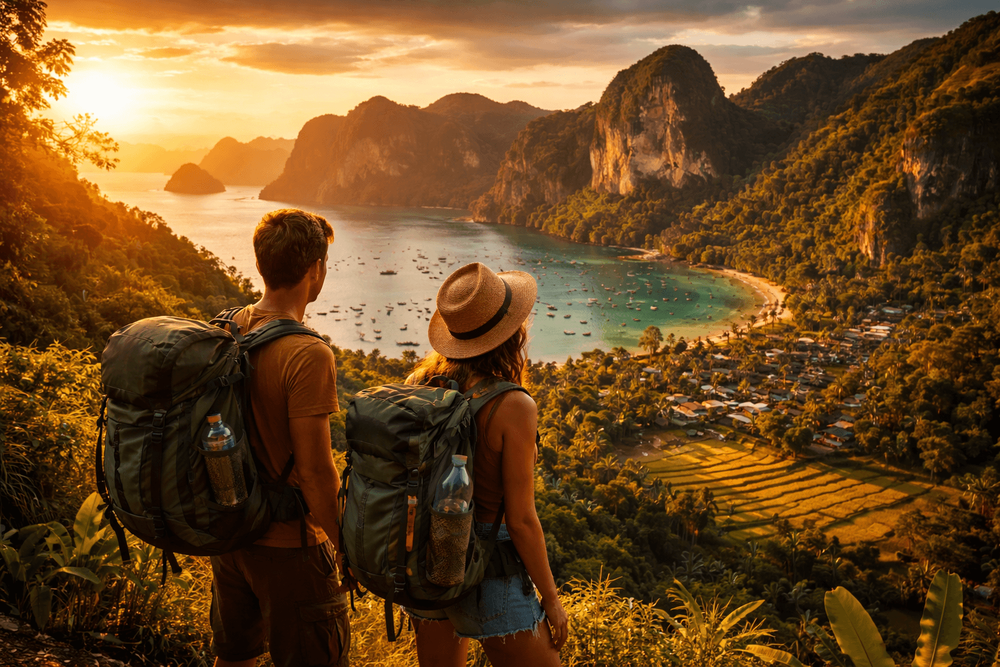
Backpacking Southeast Asia: The Definitive Guide for First-Timers
An evocative, practical primer to backpacking Southeast Asia—routes, seasons, budgets, visas, and the moments that make the journey unforgettable.
Mood
Epic Overland Adventure
At dawn in Bangkok, the air carries a mingled scent of grilled pork skewers and rain lifting from hot pavement. Long-tail boats stitch across the river, saffron-robed monks move in quiet procession, and a backpack clicks shut—zippers, buckles, anticipation. This is the threshold to backpacking Southeast Asia: an ever-shifting mosaic of street-food steam and jungle cicadas, incense and island light, ancient kingdoms and neon nights.
Why Backpack Southeast Asia Now
Backpacking Southeast Asia rewards curiosity, flexibility, and a taste for the serendipitous. It’s for travelers who prefer a night market’s clatter to a white-tablecloth hush, who will trade a few creature comforts for long conversations on trains and a sunrise seen from a temple stair. The region’s well-worn backpacker trail—vibrant but evolving—offers an approachable first long-haul trip and a lifetime of returns for veterans.
- Affordability with nuance: Street food and simple guesthouses keep daily costs modest, while boutique stays and destination dining deliver occasional, attainable splurges.
- Variety without whiplash: Ancient capitals, surf towns, limestone archipelagos, karst valleys, highland coffee farms—you’ll cross them all in days, not weeks of transit.
- Warmth and welcome: Hospitality anchors the experience, from kampung smiles to café chatter in Hanoi and music-sweet nights in Luang Prabang.
The vibe shifts by place and season. On islands, afternoons laze into hammock hours and phosphorescent swims. In cities, the tempo quickens: noodle steam fogs late windows, rooftop bars glow, motorbikes hum like beehives. Monsoons punctuate the year—at once music on tin roofs and a mood-setting filter that keeps landscapes green and crowds in check. Traveling with this rhythm, rather than against it, is part of the art.
Backpacking Southeast Asia: When to Go
Weather in Southeast Asia is not a single season but a set of overlapping monsoons and microclimates. Timing your route to chase dry windows and festivals pays dividends.
- Mainland (Thailand, Cambodia, Laos, Vietnam south): Cooler, drier from November to February; hotter March to May; wetter from roughly May to October. Rains often arrive as short, late-day bursts.
- Vietnam’s split personality: The North is cool/dry November–March and warm April–May; Central Vietnam is driest February–August and wettest October–December; the South is dry December–April and rainy May–November.
- Malaysia’s peninsulas: West coast (Langkawi/Penang) is driest December–March; east coast (Perhentians/Tioman) shines April–September and is stormy November–February.
- Indonesia (Bali, Java, Lombok): Dry season May–September; rains October–April.
- Philippines: Dry season largely November–May; typhoons possible June–October, peaking August–September.
Festival windows add cultural color:
- Thailand’s Songkran (mid-April) turns cities into joyful water fights; Loy Krathong and Yi Peng (November) set rivers and skies aglow.
- Vietnam’s Tết (Lunar New Year, Jan/Feb) brings closures and homecomings—book transport far ahead.
- Cambodia’s Bon Om Touk (Water Festival, November) fills Phnom Penh with boat races.
- Indonesia’s Nyepi (Bali’s Day of Silence, March) is a rare, island-wide pause—airports close, stars shine brighter.
- Malaysia’s Thaipusam (Jan/Feb) electrifies Penang and Kuala Lumpur with kavadi processions.
- The Philippines celebrates Sinulog and Ati-Atihan (January), MassKara (October), and countless town fiestas.
Strategize direction. Many travelers begin north (cooler, drier late year) and sweep southward to catch Indonesia’s May–September dry season. Or they follow the reverse, embracing green-season discounts and afternoon monsoon theater.
Planning Your Route by Trip Length
There is no single “right” route for backpacking Southeast Asia, but matching scope to time keeps days unhurried and meaningful. Consider these sample arcs and the day-by-day rhythms that make them sing.
2 Weeks: Temples, Cities, and a Gentle Island Finish
- Day 1–3: Bangkok. Street food in Chinatown, river ferries to the Grand Palace and Wat Pho, a day trip to Ayutthaya’s brick stupas. Evenings on rooftop terraces or at a live-music dive in Victory Monument’s orbit. Bangkok neighborhood guide
- Day 4–6: Chiang Mai and Pai. Overnight train north; temples gilded in late light; motorbike loops to Mae Sa waterfalls; cooking class and a night bazaar swirl. Pause in Pai for hot springs and bamboo-bridge strolls.
- Day 7–9: Siem Reap. Cross to Cambodia by air or overland. Sunrise at Angkor Wat, tree-strangled Ta Prohm, the pink sandstone of Banteay Srei. Cool off with an atelier visit and fish amok by candlelight.
- Day 10–14: Southern Thailand islands. Fly to Krabi or Surat Thani. Karst towers in Railay, long-tail ferries to Koh Lanta or Koh Tao. Mornings snorkeling, afternoons with iced coffee under casuarinas, evenings of grilled seafood and a last wade in warm surf.
Rhythm: Front-load big sites; schedule a buffer day around each border hop; keep island days unprogrammed.
1 Month: The Classic Banana-Pancake Loop
- Week 1: Northern Thailand into Laos. Bangkok to Chiang Mai; slow boat on the Mekong to Luang Prabang, where saffron processions and French façades linger in soft humidity.
- Week 2: Laos to Vietnam. Vang Vieng’s limestone and blue lagoons; fly or bus to Hanoi. Street corners fizz with bun cha smoke and egg coffee foam; day trip to Ninh Binh’s karst paddies.
- Week 3: Vietnam spine. Overnight train to Hue’s imperial citadel; onward to Hoi An for tailoring and lantern-lit evenings; fly to Ho Chi Minh City for café-culture mornings and wartime histories.
- Week 4: Cambodia finale. Bus to Phnom Penh’s riverfront and sobering memorials; Siem Reap for Angkor’s stone symphony; decompress in Kep or Kampot with pepper crab and sunset river cruises.
Rhythm: Alternate big-city pulses with smaller river towns; opt for overnight trains to save on rooms and daylight.
3 Months: The Grand Arc Including Malaysia, Indonesia, and the Philippines
- Month 1: Northern mainland sweep. Thailand’s north (Chiang Mai, Pai, Mae Hong Son), Laos (Luang Prabang, Nong Khiaw), northern Vietnam (Hanoi, Ha Giang Loop if experienced, Sapa terraces).
- Month 2: Vietnam to Cambodia and into Malaysia. Down Vietnam’s coast (Hue, Hoi An, Quy Nhon, Nha Trang or the quieter Cam Ranh bays, Dalat highlands, Saigon). Cross to Cambodia (Phnom Penh, Kampot, Kep, Koh Rong), then fly to Penang’s shophouses and food courts; Kuala Lumpur’s mix of mosques and markets; Taman Negara treks.
- Month 3: Islands of Indonesia and the Philippines. Bali for culture and rice terraces; sidestep to Nusa Islands or Lombok/Gili for reefs; Java for Yogyakarta and Borobudur. Finish with the Philippines: Palawan’s karst lagoons (El Nido or Coron) and Cebu’s waterfalls, or Siargao for surf.
Rhythm: Let monsoon patterns steer you; build in intentional stillness—a week in Ubud writing and resting, or a homestay near Hoi An to learn to paddle round boats.
Country Highlights & Where to Linger
Thailand
- Bangkok’s river temples and Chinatown feasts; canal-side teak houses in Thonburi; late-night jazz in dusky bars.
- North: Chiang Mai’s Lanna heritage, Mae Hong Son loop’s misty switchbacks, Pai’s hot springs. Ethical elephant sanctuaries (observe, don’t ride).
- South: Railay’s karst cathedrals, Koh Lanta’s sleepy beaches, Koh Tao’s clear bays, the Andaman’s marine parks. Where to linger: Chiang Mai for café culture and classes; Koh Lanta for long, unbroken sunsets. See the Thailand travel guide.
Vietnam
- Hanoi’s Old Quarter cacophony and tranquil lakes; street eats that define “umami.”
- The North: Ha Giang’s limestone palisades, Sapa’s terraced amphitheaters, Ninh Binh’s boat caves.
- Central: Hue’s imperial ghosts; Hoi An’s tailors and river evenings.
- South: Mekong Delta backwaters; Ho Chi Minh City’s energy; island interludes on Phu Quoc or Con Dao. Where to linger: Hoi An’s slow glow; Dalat’s pine-scented mornings. More in the Vietnam guide.
Cambodia
- Angkor’s temple constellation beyond the headliners—Banteay Chhmar, Beng Mealea.
- Phnom Penh’s café-lined boulevards and somber memorial sites that demand reflection.
- Southern coast: Kep’s crab market, Kampot’s pepper farms, the jungled islands of Koh Rong and Koh Rong Sanloem. Where to linger: Kampot’s riverfront—kayaks at dusk, pepper tastings by day. Explore the Cambodia guide.
Laos
- Luang Prabang’s UNESCO core of wats and wooden shutters; morning alms watched with respect.
- Vang Vieng’s karst valleys; Nong Khiaw’s hiking ridgelines.
- The 4,000 Islands (Si Phan Don) in the south for hammock days and river breezes. Where to linger: Luang Prabang, ideally midweek and after dawn, when bells carry across the Mekong. See the Laos guide.
Malaysia
- Penang’s street art and hawker temples; hilltop breezes on Penang Hill.
- Kuala Lumpur’s blend of minarets and mega-malls; Batu Caves’ rainbow steps.
- Rainforests of Taman Negara; coral gardens off the Perhentian and Tioman Islands (seasonal). Where to linger: George Town for food pilgrimages; Perhentians for unscripted swims. Dive deeper with the Malaysia guide.
Indonesia
- Bali’s cultural lattice—Ubud’s incense mornings, temple ceremonies, terraced rice paddies.
- Lombok’s quieter beaches and Rinjani’s volcanic vistas (skilled trekkers only).
- Java’s artistic soul in Yogyakarta; sunrise shadows at Borobudur and Prambanan.
- Nusa Penida’s cliff-backed bays; the Komodo archipelago’s pink sands and dragons. Where to linger: Ubud for a week of yoga, warungs, and waterfalls. Browse Bali stays and Bali boutique hotels.
Philippines
- Palawan’s karst lagoons (El Nido, Coron); island-hopping past hidden coves.
- Cebu’s canyons and Moalboal’s sardine run; Siargao’s surf and palm avenues.
- Northern Luzon’s Banaue and Batad rice terraces; Vigan’s Spanish-era lanes. Where to linger: Siargao for tide-tuned days and cloud-dappled sunsets. Plan with the Philippines guide.
Getting Around: Flights, Trains, Buses, Ferries, Borders, Visas
- Budget flights: Competitive low-cost carriers link hubs—Bangkok, Kuala Lumpur, Singapore, Ho Chi Minh City, Manila, Bali—often cheaper than trains. Watch baggage fees and measure carry-ons.
- Trains: Thailand’s sleepers are a rite of passage; Vietnam’s Reunification line traces the coast. Book lower berths for window views and easier boarding.
- Buses and minivans: Efficient for medium hops; look for reputable operators on intercity routes. Overnight buses in Vietnam offer lie-flat pods on key corridors.
- Ferries: Island-hopping is straightforward in Thailand, Indonesia, and the Philippines. Check seasonal sea conditions; in shoulder seasons, allow weather buffers.
- Motorbikes and scooters: Common for local exploration in Thailand, Vietnam, and Indonesia—valid license, helmet, and confidence essential; medical coverage that includes motorbike use is wise.
Border crossings and visas change regularly by nationality. Common patterns for many passports include visa-free entries or eVisas:
- Thailand: Visa-exempt stays for many nationalities (length can vary); onward ticket may be requested. Land border runs have limits—avoid relying on repeated exits/entries.
- Vietnam: eVisa widely available; select all intended entry points in the application.
- Cambodia and Laos: eVisa or visa-on-arrival at major crossings; carry USD and a passport photo.
- Malaysia, Indonesia, Philippines: Visa-free or visa-on-arrival for many travelers; confirm duration and fees before flying.
Always verify requirements on official government sites, note passport validity (typically 6+ months), proof of onward travel, and entry fee payments. Border days are best kept light—start early, keep small bills, and photograph passport/visa pages.
Budgeting & Money: What It Really Costs
Daily budgets vary by country, travel style, and season. A frugal backpacker embracing dorms and street food will spend less than one mixing in a private room and a few big-ticket activities. As a guideline (USD):
- Thailand: $35–60/day
- Vietnam: $30–55/day
- Cambodia: $30–45/day
- Laos: $30–45/day
- Malaysia: $40–70/day
- Indonesia: $35–65/day
- Philippines: $40–70/day
Typical costs:
- Dorm bed: $6–$15 (higher in Bali, Manila, island hotspots)
- Simple private room: $18–$35
- Street meal: $1.50–$4; café brunch in capitals: $5–$10
- Long-distance train (Vietnam/Thailand): $12–$35 depending on class and distance
- Domestic flight: $30–$120; ferry hops: $5–$25
- Scooter rental: $5–$10/day (plus fuel)
Money tips:
- ATMs are widespread in cities; fees range $2–$6 per withdrawal—take out larger amounts where safe and split cash between bags.
- Cards vs cash: Cash still rules in markets and small homestays; cards work at midrange hotels and urban restaurants.
- Tipping: Not obligatory region-wide. Round up small bills; 5–10% appreciated for standout service or in more formal venues. Tip dive crews and guides modestly.
- SIM cards and data: Local SIMs are inexpensive and fast. Look for major providers at airports or city shops—Thailand (AIS/DTAC), Vietnam (Viettel/MobiFone), Cambodia (Smart), Laos (Unitel), Malaysia (Maxis/Celcom), Indonesia (Telkomsel/XL), Philippines (Globe/Smart). Expect ~$5–$12 for 10–20 GB. eSIMs simplify hopping if your phone supports them.
- Exchanges: Use licensed money changers; avoid suspiciously good rates. Keep crisp USD notes for certain visas.
Where to Sleep and How to Book
- Hostels: Social hubs with mixed or female-only dorms, often with pools in Thailand, rooftop terraces in Vietnam, capsule pods in Malaysia. Seek properties with privacy curtains, lockers, and communal kitchens.
- Guesthouses: Family-run stays with breakfast and local intel—especially rewarding in Laos, Cambodia, and rural Vietnam.
- Boutique stays: Converted shophouses in Penang, eco-lodges in northern Thailand, design-forward riads of Bali’s backstreets. Ideal for a once-a-week upgrade. See Bangkok boutique hotels and Bali boutique hotels.
- Beach bungalows: On islands from Koh Lanta to the Gilis and Palawan, bamboo-and-breeze is still a thing. Book ahead in peak months; in shoulder seasons, walk-ins can net bargains.
Booking rhythm:
- Peak periods (December–February; major holidays): Reserve a few days ahead, more for islands and festivals.
- Shoulder and green seasons: Book the first night, then scout in person for better rates and vibe.
- Night trains and ferries: Reserve early for preferred berths and calmer crossings.
Health, Safety & Packing
Southeast Asia is welcoming and well-traveled; basic precautions and cultural respect go a long way.
Health and vaccinations:
- Consult a travel clinic about routine vaccines (e.g., tetanus-diphtheria, hepatitis A, typhoid). Depending on itinerary, others may be advised.
- Dengue is present; there’s no vaccine widely recommended for travelers—use repellent and cover up at peak mosquito hours. Malaria risk exists in some rural border areas—seek medical guidance.
- Tap water is not potable in most places; refill bottles at hostel stations and cafés. Many destinations now support water-refill networks.
Safety and savvy:
- Common scams: “Closed temple” diversions in Bangkok, inflated tuk-tuk tours, unscrupulous motorbike rentals, and unofficial money changers. Use meters or agree on fares; inspect scooters carefully and photograph pre-existing damage.
- Nightlife sense: Guard drinks; pace yourself under tropical heat. Full Moon gatherings are festive—choose trusted transport and watch the tide line.
- Roads and riding: Helmets always; avoid night riding outside towns; be cautious on mountain loops in Laos and Vietnam.
- Documents: Cloud-backup passport/visa pages; carry a digital and a paper copy.
Sustainable travel tips:
- Respect temples: Shoulders and knees covered; remove shoes where indicated; keep voices soft in active shrines.
- Wildlife ethics: Skip elephant riding and animal shows; choose observation-based sanctuaries and reef-friendly operators.
- Plastic light: Carry a filter bottle, refuse straws, refill where possible. Use reef-safe sunscreen; never touch coral; avoid anchoring or standing on reefs.
- Local economies: Eat at family-run warungs and hawker stalls; take local guides on hikes; book homestays—your money resonates locally.
Printable Packing Checklist
- Passport (6+ months validity), visas/eVisas, 4x passport photos, travel insurance details
- Bank cards (separate debit/credit), some crisp USD, hidden backup cash
- Phone with eSIM or unlocked for local SIM; lightweight power bank
- Universal adapter (Type A/C/G common), short and long charging cables
- Lightweight daypack; packable tote; small lock for lockers
- Quick-dry clothing: 3–4 shirts, 2–3 shorts, 1 long pant, light sweater
- Sarong or scarf (temples, beach, AC buses), light rain jacket/poncho
- Swimwear; microfiber towel; flip-flops and breathable walking shoes
- Sun hat, sunglasses; reef-safe sunscreen; lip balm with SPF
- Mosquito repellent (DEET or picaridin); anti-itch cream
- Basic pharmacy: plasters, antiseptic wipes, pain reliever, rehydration salts, antihistamine, personal meds in original packaging
- Refillable water bottle (preferably with filter); collapsible coffee cup
- Headlamp; earplugs; sleep mask
- Dry bag for boats and monsoon days; zip pouches for cables/papers
- Compact first-aid and sewing kits; travel-size laundry soap
The Lasting Image
Evening on the Mekong. A fisherman lifts a net, droplets turn to copper in the last light, and somewhere a long-tail coughs to life. A bowl of lemongrass soup steams on a plastic table; geckos click on stucco. The day’s miles—train, ferry, foot—settle into a quiet satisfaction. Backpacking Southeast Asia isn’t a single route but a way of moving: slow enough to notice the incense curling in a doorway, hungry enough to try whatever sizzles next, open enough to let the weather, the festival, the chance encounter rewrite tomorrow.