
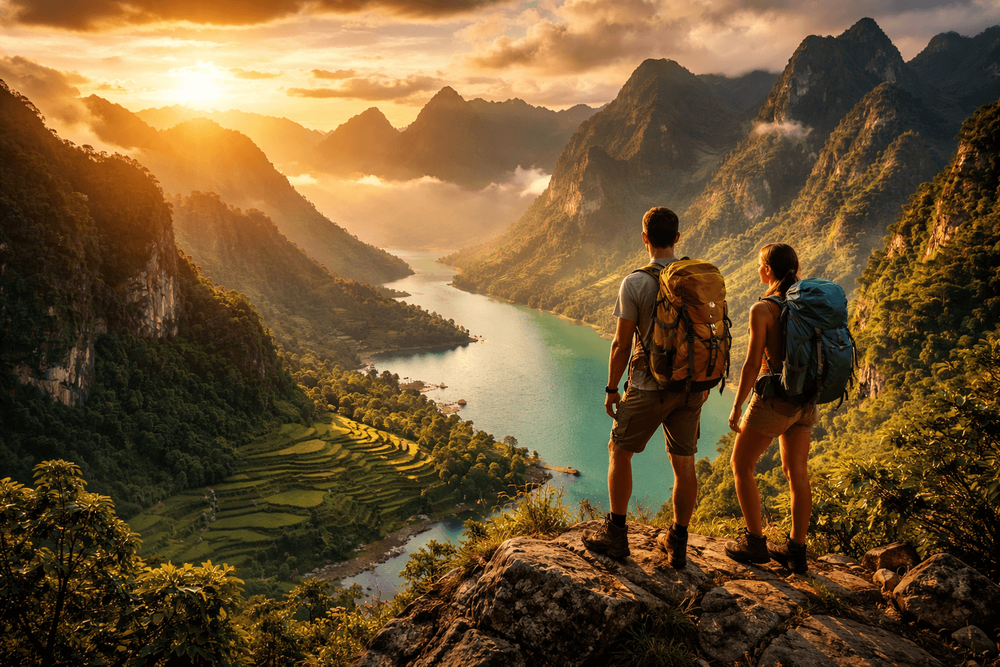
The Best Backpacking Destinations for 2026: Routes, Budgets & Tips
Where to shoulder the pack in 2026: classic and emerging routes, sample itineraries, budgets, safety, and the art of choosing your next destination.
Mood
Global Adventure
Dawn slips across a bus station in Luang Prabang as roosters stir and a kettle hisses. The shoulder straps click into place; a map crinkles; steam from a metal cup curls into cool air. For many, the next great story begins in a moment like this — one foot in the familiar, the other stepping toward the best backpacking destinations, where the days are strung together by border stamps, bus windows, and meals shared with strangers who become the backbone of the journey.
Why Backpacking in 2026
Backpacking in 2026 suits travelers hungry for immersion and elasticity — the kind of trip that flexes with the weather, the wallet, and the whims of a conversation overheard in a hostel kitchen. Borders have broadly reopened, night trains are returning to fashion, cross-border buses are more connected than ever, and eSIMs make landing in a new country less daunting. This guide is built for first-timers planning a dream sabbatical, veteran overlanders plotting a longer arc, and anyone comparing the best backpacking destinations against time, budget, and season.
What travelers will get here:
- A framework for choosing where to go — from climate to culture to cost.
- Regional highlights and the textures that define them.
- Signature routes with sample 2–6 week itineraries for different travel styles.
- Budget ranges, transport know-how, and smart logistics.
- Health, safety, and seasonal insights to keep plans smooth.
- Packing and tech essentials to stay light and connected.
- A planning checklist and further reading to move from dream to dates.
How to Choose Your Next Backpacking Destination
Picking a place is less a science than a match between energy and environment. Consider:
Vibe and velocity
- Social or solitary: Southeast Asia’s hostel scene hums with taco nights and rooftop trivia; the Balkans mix easy camaraderie with slow coffees; Central Asia trades bar crawls for yurt stays under a Milky Way sky.
- Urban or wild: Europe strings cities by rail; New Zealand rewards trailheads and road trips; the American Southwest unfurls red-rock canyons and star fields.
- Culture-forward or nature-first: South America blends Inca stones with high-altitude trekking; East Africa pairs Swahili coast rhythms with safari savannas.
Season and weather
- Monsoons, dry seasons, and winter closures reshape routes. Start with a preferred travel window, then map candidates whose weather aligns.
- Shoulder seasons (spring and autumn in Europe; May–June and September–October in much of Southeast Asia; May–September in the Andes) balance crowds and cost.
Budget and value
- Daily budgets vary widely and depend on dorm vs. private rooms, street food vs. cafés, buses vs. flights. Use ranges below, then add a buffer for surprises.
Visas and borders
- Rules depend on passport and change often. Many nationalities receive visa-free or visa-on-arrival access across Southeast Asia and parts of Latin America, while East Africa and Central Asia increasingly offer e-visas. Always confirm with official government sources and allow extra time for any permits.
Best Backpacking Destinations by Region & Vibe
Southeast Asia: Social circuits and island time
The region’s classic “Banana Pancake Trail” still earns its status: temples that glow like coals at dawn, banana-leaf parcels of sticky rice, and buses that wind past neon-green paddies. Thailand’s north (Chiang Mai, Pai) invites slow mornings and mountain loops; Laos soothes with the low-slung melody of the Mekong; Vietnam’s spine ties limestone bays to imperial cities and lantern-lit alleys; Cambodia holds the stonework symphony of Angkor and coastal escapism in Kep and Kampot. Indonesia offers volcanic sunrises in Java, surf and ceremony in Bali, and coral gardens across the Nusa and Gili archipelagos.
- Typical budget: USD 30–60/day (dorms, local eats, buses; island hops and diving add cost).
- Vibe: Highly social hostels, easy overland links, low-stress entries for first-time backpackers.
- Timing: Nov–Mar for mainland dry months in many areas; May–Sep for Indonesia’s drier season; weather varies by subregion.
South America: Altitude, color, and long horizons
From the Andean backbone to jungle basins and wild Atlantic cities, South America rewards patience and wide-angle curiosity. Peru fuses ceviche and colonial plazas with Sacred Valley trails; Bolivia’s salt flats feel lunar and limitless; Colombia’s Caribbean winds lead from Tayrona’s palm-fringed coves to Medellín’s hilly barrios; Argentina stretches from Patagonian ice to Malbec nights; Chile lines up desert stars in Atacama and Pacific surf further south; Ecuador compacts cloud forest, volcanoes, and markets into easy hops.
- Typical budget: USD 40–80/day (long distances and national park fees influence costs).
- Vibe: Deep cultural layers, Spanish immersion, treks and night buses.
- Timing: Andes dry season roughly May–Sep; Patagonia is prime Nov–Mar; Amazon rainfall ebbs and flows regionally.
Europe: Rails, rivers, and café culture
Europe remains a consummate training ground for independent travel. The Balkans — Croatia’s Dalmatian isles, Bosnia and Herzegovina’s storied bridges, Montenegro’s fjord-like bays, Albania’s Accursed Mountains — deliver big scenery at lower cost. Iberia pairs pilgrim routes and pintxos; Central Europe’s Danube chain offers castles and thermal baths; night trains are resurging, easing cross-border hops.
- Typical budget: USD 50–120/day (Balkans and parts of Eastern Europe on the lower end; Western Europe higher).
- Vibe: Rail romance, walkable cities, hostel mixers and museum marathons.
- Timing: Apr–Jun and Sep–Oct shine; July–Aug bring heat and crowds to hotspots.
Central Asia: Silk Road cities and alpine grasslands
Between steppe and summits, Central Asia rewards those who love tea-house talk and open space. Uzbekistan’s turquoise-domed Samarkand, Bukhara, and Khiva read like a tiled epic; Kyrgyzstan’s jailoo summer pastures welcome trekkers to yurt camps and lake circuits; Tajikistan’s Pamir Highway demands time and grit but pays in stargazing and high-mountain hospitality.
- Typical budget: USD 35–65/day (shared taxis and remote treks can add variability).
- Vibe: Fewer crowds, warm home-stay culture, big-sky trekking.
- Timing: Jun–Sep for high-country trails; spring and autumn for Silk Road cities.
Africa: Coastlines, culture, and conservation landscapes
North Africa braids souks and Sahara dunes with Roman ruins and coastal breezes: Morocco’s medinas and Atlas hikes, Tunisia’s mosaics and desert ksour. East Africa blends wildlife corridors with Indian Ocean reprieves: Kenya’s Rift Valley lakes, Tanzania’s crater rims and spice-fragrant Zanzibar. Southern Africa layers road-trip independence across South Africa’s Garden Route, Drakensberg trails, and wild Eastern Cape surf.
- Typical budget: USD 45–90/day (wildlife safaris increase costs; group sharing helps).
- Vibe: Strong sense of place, from Swahili coasts to Berber villages; open-road energy.
- Timing: North Africa is gentler Oct–Apr; East Africa’s long rains often Mar–May; Southern Africa dry season roughly May–Oct for game viewing.
Oceania: Trails, tides, and road-trip rhythm
New Zealand reads like a catalog of landscapes: jade bays in Abel Tasman, wind-scrubbed tussocks in Otago, mirror lakes in Fiordland. Australia scales up the distances — tropical Queensland, the Great Ocean Road’s limestone drama, the Blue Mountains’ eucalyptus haze — with hostel networks anchoring city to surf town.
- Typical budget: USD 70–130/day (self-catering and campervan shares reduce costs).
- Vibe: Hikes by day, hostel kitchens by night, friendly road culture.
- Timing: NZ and southern Australia excel Nov–Apr; the tropical north is best in the dry (roughly May–Oct).
North America (including Mexico & Central America): Canyons, colonial cores, and coasts
Mexico and Central America stitch together volcano hikes, cenotes, and plazas scented with grilled maize. Mexico City fuels museums and mezcal bars; Oaxaca’s valleys carry culinary traditions; the Yucatán mixes ruins and reefs. Guatemala’s Lake Atitlán villages sit under volcano silhouettes; Nicaragua layers surf towns with colonial Granada. In the U.S. and Canada, the great outdoors pulls hard: Utah’s red-rock labyrinths, California’s High Sierra, Canada’s alpine lakes.
- Typical budget: USD 35–60/day in Mexico and much of Central America; USD 70–140/day in the U.S. and Canada (car shares help considerably).
- Vibe: Street-food feasts, Spanish practice, big landscapes and national parks.
- Timing: Dry season for much of Central America runs Nov–Apr; U.S. Southwest is best spring and autumn; Canadian Rockies peak Jun–Sep.
Signature Backpacking Routes & Sample Itineraries
Use these as scaffolding; swap in detours as conversations and weather allow.
4 Weeks: Mainland Southeast Asia “Trail Lite”
- Bangkok (3–4 days): Street-food alleys, canal rides, golden spires. Bangkok Neighborhood Guide
- Chiang Mai & Pai (5–6 days): Night markets, motorbike loops to waterfalls and canyons.
- Luang Prabang (3–4 days): Monk processions at dawn, Kuang Si falls, Mekong sunsets.
- Hanoi, Ninh Binh, and Ha Long or Lan Ha Bay (6–7 days): Egg coffee, karst towers, sampan rides amid emerald rice.
- Hue & Hoi An (4–5 days): Imperial citadel, tailors, lantern-lit riverfronts.
- Ho Chi Minh City (3–4 days): War history, rooftop views, market bustle.
- Siem Reap (3 days): Sunrise over Angkor, bicycle circuits among roots and stone.
Transport: Buses and sleeper trains; short regional flights save time on long hops.
3–5 Weeks: Andean Circuit — Peru and Bolivia
- Lima (2 days): Coastal clifftops, cevicherías, colonial cores. Peru Essential Guide
- Cusco & Sacred Valley (6–8 days): Sacsayhuamán stones, markets, acclimatization hikes. Machu Picchu via permit-secured trail or train day trip. Machu Picchu Travel Guide
- Arequipa & Colca (3–4 days): White-stone cloisters, canyon condors.
- Lake Titicaca (2–3 days): Island homestays, altiplano light.
- La Paz (3–4 days): Cable-car cityscapes, valley hikes; optional Death Road cycling.
- Salar de Uyuni (3 days): 4x4 salt and high-altiplano lagoons; continue to Sucre for colonial calm.
Transport: Night buses, Andean flights for long stretches; allow buffer days for altitude.
3–4 Weeks: The Balkan Loop
- Split or Dubrovnik (3–4 days): Fortified towns, island day trips.
- Mostar and Sarajevo (4–5 days): Ottoman bridges and poignant 20th-century history.
- Kotor Bay (2–3 days): Ladder hikes above a fjord-like blue.
- Shkodër & Theth (4–5 days): Albania’s Accursed Mountains — the Theth–Valbonë trek and local guesthouses.
- Tirana & Albanian Riviera (4–5 days): Beach coves and bohemian cafés.
- Ohrid or Skopje (2–3 days): Lakeside monasteries or urban murals.
Transport: Buses and minibuses knit borders; ferries stitch Dalmatian islands.
3–4 Weeks: Silk Road Sampler — Uzbekistan and Kyrgyzstan
- Tashkent (2 days): Soviet-era metro mosaics and modern markets.
- Samarkand, Bukhara, Khiva (7–9 days): Registan blues, caravanserai courtyards, desert sunsets.
- Almaty or direct to Bishkek (transit): City parks and mountain backdrops.
- Karakol & Issyk-Kul (6–8 days): Trekking to alpine lakes, yurt stays, lakeside hot springs.
- Bishkek (2 days): Leafy boulevards, bazaars, café resets before onward routes.
Transport: High-speed trains in Uzbekistan, shared taxis, and marshrutkas in Kyrgyzstan.
4–6 Weeks: East Africa Overland — Kenya and Tanzania
- Nairobi (2–3 days): Markets and museums; city safaris in Nairobi National Park.
- Rift Valley Lakes (4–5 days): Naivasha cycling among giraffes; Nakuru flamingos.
- Maasai Mara or budget group safari (3–4 days): Shared costs, shared sightings.
- Arusha (2–3 days): Gateway to Serengeti/Ngorongoro circuits (consider joining others to split 4x4 costs).
- Moshi & Kilimanjaro foothills (2–3 days): Waterfalls and coffee farms.
- Zanzibar (5–7 days): Stone Town spice history and beach interludes from Matemwe to Paje.
Transport: Buses (matatus/dala-dalas), shared safari vehicles, Zanzibar ferries.
2–3 Weeks: New Zealand Backpacker Loop — North to South
- Auckland to Coromandel (2–3 days): Cathedral Cove and beach-town tempo.
- Rotorua/Taupō (2–3 days): Geothermal walks; Tongariro Alpine Crossing on a clear day.
- Wellington (2 days): Compact culture, windswept views.
- South Island ferry to Nelson/Abel Tasman (2–3 days): Coastal track day walks.
- West Coast to Wanaka/Queenstown (4–5 days): Glacial valleys, alpine switchbacks.
- Fiordland (2–3 days): Milford or Doubtful Sound — rain-etched cliffs and blackwater lakes.
Transport: Intercity buses, car shares, or campervan splits; book key huts/tracks ahead in peak months.
2–3 Weeks: American Southwest — Red-Rock Odyssey
- Las Vegas or Phoenix entry.
- Zion & Bryce (4–5 days): Narrows, angels, hoodoos.
- Capitol Reef & Moab (4–5 days): Petroglyphs, Arches and Canyonlands.
- Monument Valley (1–2 days): Tribal park landscapes.
- Grand Canyon & Sedona (4–5 days): Rim walks, crimson buttes, creek canyons.
Transport: Car rental shared with hostel mates; reserve park shuttles and popular trail permits where required.
Budgeting & Logistics — Transport, Beds, and Bookings
Daily costs and where the money goes
- Beds: Dorms anchor budgets; private rooms in guesthouses (posadas, riads, pensiones) stay affordable in many regions. Expect dorms from USD 6–15 in Southeast Asia, USD 10–25 in parts of Latin America and the Balkans, and USD 25–45 in Oceania, the U.S., and Western Europe (ranges vary by season and city).
- Food: Local markets and street stalls rule value; self-cater in high-cost regions. Splurge selectively on signature dishes and long-day rewards.
- Transport: Night buses and trains fold lodging into the fare; low-cost flights unlock distance but add baggage fees; regional rail passes in Europe fit multi-country sprints if used frequently.
Booking rhythm
- In high season, lock in popular hostels and major transport a few days to a week ahead. Elsewhere, book 24–72 hours ahead to keep spontaneity.
- On long hauls, favor reputable operators and daytime departures when roads are rough; arrive with small bills and snacks.
Rail and road strategy
- Europe: Mix point-to-point fares with passes if riding trains most days. Some countries require seat reservations for fast services — check national rail sites.
- Latin America and Southeast Asia: Bus networks reach deep; VIP or “executive” classes trade a few dollars for safety and comfort.
- Oceania and North America: Distances sprawl; car shares and campervan splits reduce cost. In New Zealand and Australia, national bus networks and regional shuttles connect popular trailheads.
Money and connectivity
- ATMs cluster in cities; carry a backup card and a small USD/EUR reserve. Expect some rural cash-only spots.
- Local SIM or eSIM keeps maps and messaging live; purchase at airport kiosks or city shops and know the APN settings. Keep copies of passport data pages in secure cloud storage.
Health, Safety, and Seasonal Timing
Staying healthy
- Vaccinations: Routine immunizations (e.g., tetanus) plus region-dependent jabs such as Hepatitis A and Typhoid are common recommendations; Yellow Fever certificates may be required for entry to or from certain countries. Consult a travel health professional well ahead of departure.
- Altitude: The Andes and parts of East Africa climb quickly. Build in acclimatization days; hydrate, ascend gradually, and know symptoms of acute mountain sickness.
- Mosquito-borne illness: Prevention is key — long sleeves at dusk and dawn, repellent, and treated bed nets where needed. Malaria prophylaxis depends on region and season.
- Water and food: Purify water via filters, UV pens, or tablets; choose busy food stalls with high turnover; carry a basic first-aid kit.
Staying safe
- Petty theft: Use hostel lockers, divide cash/cards, and carry daypacks on laps during bus stops. A simple cable lock secures a bag to fixed points.
- Transport: Night buses save money but trade visibility; weigh local advice, operator reputation, and road conditions.
- Cultural norms: Dress codes near religious sites; photography etiquette in markets and villages; extra awareness during holy months and festivals. LGBTQ+ travelers should verify local laws and community resources.
- Documentation: Keep digital and paper copies of passports, visas, and key bookings; know embassy contacts.
Seasonal smarts
- Southeast Asia: Monsoons roll through at different times — plan islands and overland routes accordingly. Avoid heavy ferry days during storms.
- Andes and Patagonia: Dry season trekking May–Sep in Peru/Bolivia; Patagonia’s winds ease Nov–Mar.
- Europe: Shoulder seasons mean softer light and saner prices.
- East Africa: Wildlife is stellar in the dry months; long rains can make roads muddy and park access tricky.
- Caribbean and parts of North America: Hurricane season typically Jun–Nov; flexible itineraries help.
Packing, Apps & On-the-Ground Resources
The pack itself
- A carry-friendly 35–45L backpack fits overhead bins and trains; add a light daypack.
- Essentials: Rain cover, quick-dry layers, a warm mid-layer, trail shoes, flip-flops, microfiber towel, headlamp, packable sun hat, sunglasses, refillable bottle, compact first-aid kit, and earplugs.
- Sleep system: Silk or microfiber liner for guesthouse beds or overnight buses.
- Security: Small padlock, short cable, card sleeve, and a discreet money belt or neck pouch for crossings.
- Tech: Unlocked phone with dual-SIM or eSIM, universal adapter, power bank, cloud backups of documents.
Digital tools without the clutter
- Offline maps for trails and cities; downloadable phrasebooks and translators; a currency converter; and a simple notes app for bus times and homestay addresses.
- Keep screenshots of booking confirmations for border posts with spotty data.
Hostels, overland groups, and community
- Social hostels organize walking tours, family dinners, and barbecues — ideal for solo travelers seeking trail mates.
- Bulletin boards and group chats in hostels and traveler cafés spark ride shares and group treks (especially in Patagonia, Kyrgyzstan, and national parks in the U.S.).
- Local tourism offices remain gold for trail conditions, park permits, and opening hours.
Staying connected affordably
- Buy a local SIM when longer than a week in-country; for multi-country swings, an eSIM with regional coverage can bridge gaps. Confirm tethering policies for laptop days.
- Set messaging apps to low-data modes and download music and podcasts on Wi‑Fi.
Next Steps: Checklist, Further Reading, and Internal Resources
Planning checklist
- Choose a 2026 travel window; shortlist 2–3 regions whose seasons align.
- Scan entry rules and visa requirements for passport and route; build in buffer days after long-haul flights.
- Sketch a backbone route with 3–5 anchor stops; identify 1–2 must-book experiences (e.g., major treks, park permits).
- Model a daily budget with a 15–20% cushion; price key intercity moves.
- Reserve first two nights and an airport/city transfer; leave later nights flexible.
- Book essential vaccines and gather a compact medical kit.
- Sort connectivity: unlock phone, decide on eSIM/local SIM plan.
- Share itinerary breadcrumbs with a trusted contact; store document copies securely.
- Pack once, then remove 20%.
Further reading and internal links
- Regional deep dives: Southeast Asia on a Budget, Peru Essential Guide, Balkans Travel Guide, Africa Overland Basics, New Zealand South Island Road Trip
- Timing and routes: Best Time to Visit Southeast Asia, Europe by Train: A Practical Guide, South America Itinerary Ideas
- Skills and safety: Backpacking Packing List, Travel Safety 101, Visa & Entry Basics
- Where to stay: browse Hostels & Stays and destination hubs like City Guides
Backpacking remains the most elastic way to know a place — to feel a city’s cadence from its curbside grills, to trace mountain contours with a day’s stride, to find that conversation that reshapes the map. Whether the compass points toward karst and lanterns, salt flats and starfields, café tables and night trains, or red-rock amphitheaters, the best backpacking destinations in 2026 are the ones that align budget, season, and appetite — and leave enough blank space for serendipity to write the rest.