
Belarus Through Time: Key Historical Sites, Stories, and Practical Tips
UNESCO castles, wartime memorials, synagogues, and manors—discover Belarus’s layered past with evocative stories, thoughtful routes, and respectful travel tips.
Mood
Cultural Deep-Dive
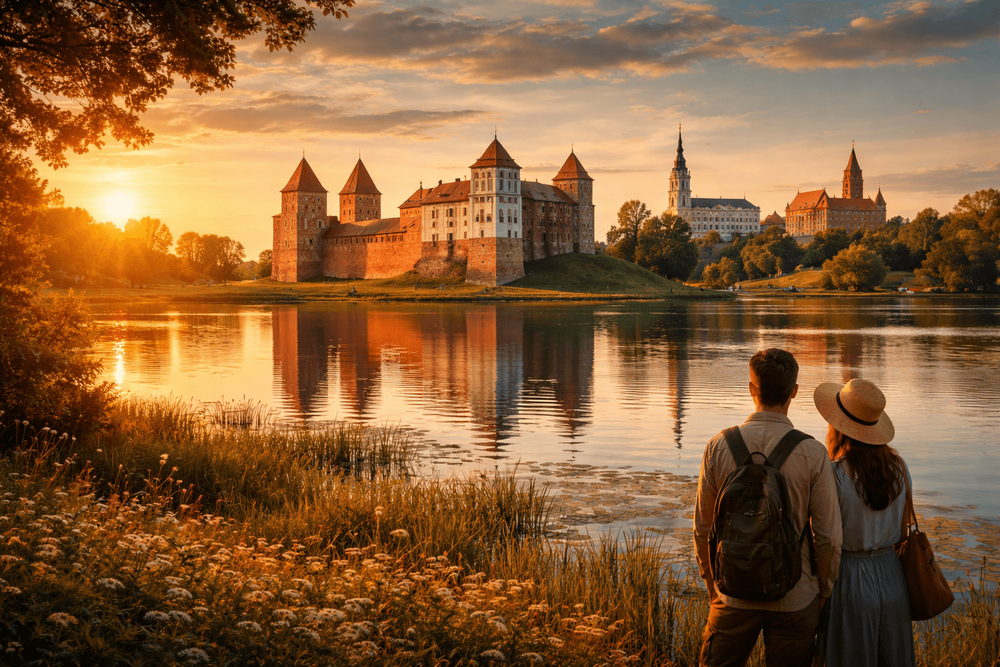
At daybreak, mist lifts from the red‑brick turrets of Mir Castle as storks trace lazy circles over the moat. A bell tolls somewhere beyond the fields, and the echo carries across centuries—a fitting overture to exploring the historical sites in Belarus. Here, medieval dynasties, borderland faiths, wartime scars, and Soviet memory overlap so closely that travelers can feel the sediment of time beneath every footfall.
Essential Historical Sites in Belarus
Mir and Nesvizh: The Radziwill Legacy of the Grand Duchy
Mir Castle and the palace‑and‑park ensemble at Nesvizh are Belarus’s marquee UNESCO World Heritage Sites—two chapters in the saga of the powerful Radziwill magnates. Mir’s polygonal towers and stout curtain walls speak the muscular language of late medieval defense, but step inside and you find Renaissance flourishes, family heraldry, and rooms that recall the cosmopolitan tastes of the Grand Duchy of Lithuania. An hour’s drive away, Nesvizh unfurls a different mood: a Baroque palace reflected in a mirror‑calm lake, terraced gardens, and the Corpus Christi Church—the Radziwills’ burial crypt and one of the earliest Baroque churches in the region. Together, the castles anchor Belarus in the era when Vilnius and Kraków set courtly fashions and multiethnic communities traded in the market squares.
Practical notes: Both complexes are well restored and visitor‑friendly, with museums, audio guides, occasional concerts, and cafes. Expect weekend wedding photo shoots and local families strolling the grounds. Many travelers pair Mir and Nesvizh as a single day‑trip loop from Minsk (about 300 km round‑trip by car). For broader context on these and other marquee stops, see Belarus’ Must‑See Landmarks: Castles, Memorials & Natural Wonders (/experiences/belarus-must-see-landmarks-castles-memorials-natural-wonders).
Curated stay: Between the castles, a converted manor house like the Hotel Name offers parquet‑floored rooms, lakeside sunsets, and easy morning access before tour buses arrive.
Brest Hero‑Fortress: The First Day of the War
On June 22, 1941, the Wehrmacht struck at dawn. In Brest, the garrison’s resistance turned a 19th‑century fortress into a legend—its redoubts still tattooed with defenders’ last inscriptions. Today, visitors pass through a star‑shaped aperture cut into a concrete block and enter a vast memorial landscape. The “Courage” monument’s granite visage looms over parade grounds; a soft drip of water resonates in casemates where thirst and siege once defined the day; the Kholmsky Gate stands in photogenic ruin along the river.
Practical notes: The site combines open‑air memorials, museums, and chapels, with English signage in key areas. Allow at least half a day. Consider adding the excellent “Berestye” Archaeological Museum—an indoor excavation of a 13th‑century wooden town captured under glass—located within the fortress grounds.
Curated stay: A characterful townhouse like the Hotel Name places travelers a short riverside stroll from the fortress, ideal for early light on the brick ramparts.
Khatyn and the Landscape of Loss
Khatyn is not a village but a void. In 1943, its inhabitants were massacred, one of hundreds of Belarusian communities erased during Nazi anti‑partisan operations. The memorial’s grammar is silence: concrete chimneys mark vanished homes; bells ring at intervals; the statue “The Unconquered Man,” a father cradling his son, fixes the visitor in place. Khatyn’s design also speaks to Soviet memorial culture, channeling grief into a language of collective endurance. Yet its power is deeply personal, insisting on names, ages, and the ordinary lives that ended here.
Practical notes: Khatyn lies an hour north of Minsk by road. The grounds are open‑air and serene; winter visits carry a stark, moving beauty. Dress warmly and walk slowly—snow muffles the bells but amplifies the experience.
Maly Trostenets, The Pit, and Jewish Memory
Belarus’s Jewish story is foundational: market‑town shtetls, rabbinic scholarship, artisans, and traders who braided the country into the Jewish heartland of Eastern Europe. The Holocaust severed that continuum. Near Minsk, the Maly Trostenets extermination site—where tens of thousands of local Jews, Belarusian civilians, and deportees from across Europe were murdered—has a growing memorial complex of sculptures, steles, and burial trench markers. In central Minsk, the Yama (the Pit) memorial began as a stark 1947 obelisk; a later bronze procession descends the steps, humanizing statistics into silhouettes of neighbors.
In Hrodna (Grodno), the Great Choral Synagogue—partly restored—hosts a small museum and community events, a fragile continuity after wartime deportations. The Slonim synagogue stands grand and peeling, its renaissance‑baroque volume a reminder of both vanished congregations and the challenges of preservation in smaller towns. In Mir, visitors can couple the castle with the Jewish quarter and cemetery, reading plaques that fill in the faces behind the stones.
Practical notes: Modest dress, head coverings for men in synagogues, and sensitivity with photography—always ask. English interpretation at Trostenets is partial; a guide in Minsk can contextualize the landscape of sites, including ghetto memorials and lesser‑known plaques hidden in courtyards.
Churches that Anchor the Past
Religious architecture in Belarus charts shifting borders and blended traditions. The 12th‑century Kalozha Church of Sts. Boris and Gleb in Hrodna remains one of the country’s oldest surviving Orthodox churches, its walls inlaid with colored stones and ceramic inserts that catch late‑afternoon light over the Neman River. In Polotsk, the Cathedral of St. Sophia—originally 11th century, refashioned in an 18th‑century Baroque costume—symbolized a Rus’ city in dialogue with Kyiv and Novgorod, later absorbing the flourishes of the Polish‑Lithuanian Commonwealth. In Minsk, the Cathedral of the Holy Spirit, once a Bernardine abbey, personifies the city’s Orthodox present layered over Catholic origins.

Happyluxe Travel Shawl Wraps for Women - 68x35in Wrap. Lightweight Pashmina, Airplane Travel Blanket Scarf. Made In USA at Amazon Women’s Clothing store
View on AmazonPractical notes: Expect services in Belarusian or Church Slavonic; candles and icons invite quiet contemplation. Check hours for concerts at St. Sophia, as its acoustics are sublime.
Military Lines and Memory Mounds
Northwest of Minsk, the Stalin Line historical complex reconstructs interwar Soviet fortifications: trenches laced with dew‑wet grasses, anti‑tank “dragon’s teeth,” and bunkers that hum with the metallic smell of cosseted steel. It is equal parts museum and open‑air experience; reenactment days add spectacle, so those seeking solemnity may prefer quieter weekdays. Eastward, the Buinichy Field near Mogilev memorializes the city’s defense in 1941 with a chapel, obelisk, and tanks settled into the meadow’s green. Closer to the capital, the Mound of Glory rises like a grassy ziggurat crowned by bayonets—quintessential Soviet monumentalism celebrating the liberation of Belarus.

Amazon.com | Moab 3 Waterproof | Hiking Shoes
View on AmazonPractical notes: Wear sturdy shoes; many paths are uneven. Some complexes offer limited English interpretation; audio guides or local docents deepen the visit.
Palaces, Manors, and Urban Castles
The Ruzhany Palace—once the Sapieha family’s “Versailles”—unfurls in romantic ruin, its colonnaded façade a sepia photograph come to life. Restoration is ongoing; the gatehouse hosts a small museum, and scaffolding signals slow rebirth. Nearby, the neo‑Gothic Kosava Palace has seen sections meticulously restored, its creamy crenellations dazzling against spring greens. In Gomel, the Rumyantsev‑Paskevich Residence presides over the Sozh River: a neoclassical palace, winter garden, and park that draw picnickers and wedding bands in golden‑hour light.
In Hrodna, the Old and New Castles face each other across a crenellated debate—medieval fortification and 18th‑century residence—together narrating the city’s tenure as a royal seat. Expect ongoing renovations; check site notices for access to interiors.
Archaeology Under Glass and the Measure of the Earth
Few places make the Middle Ages as tactile as the “Berestye” Archaeological Museum, where streets, wooden houses, and workshops from the 1200s remain in situ beneath a modern roof. North of Minsk, the ancient town of Zaslavl (Zaslaŭje) offers earthwork ramparts and two historic churches, an easy half‑day exploration by train. Scattered across Belarus, modest markers plug the country into a grander scientific narrative: the Struve Geodetic Arc. These 19th‑century triangulation points—today a UNESCO World Heritage transnational site—once helped measure the meridian and the planet itself.
For more inspiration across regions and eras, explore Top Attractions in Belarus — Must‑See Sights & Unique Experiences (/experiences/top-attractions-in-belarus-must-see-sights-unique-experiences).
People, Memory, Museums: How History is Remembered
Belarus’s historical sites are not only stones and statues; they are repositories of testimony. At Brest Fortress, museum rooms preserve penciled scrawls—dates, names, a last “We held out.” At Khatyn, docents speak of relatives from villages that no longer exist, their narratives braided with the chime of bells. In Minsk, the Belarusian State Museum of the History of the Great Patriotic War arranges artifacts—field radios, letters, partisans’ skis—into a lucid journey from invasion to liberation, all within soaring modernist halls.
Jewish memory is often stitched together by caretakers and small communities: volunteers who unlock synagogues, teachers who collect oral histories, grandchildren who return with photographs. The tension between immaculate restorations and weathered authenticity is visible everywhere—Ruzhany’s scaffolds, Slonim’s flaking stucco—prompting questions about what to rescue and what to let stand as witness. Travelers attuned to these stories will find that historical sites in Belarus are at once museums of material culture and open conversations with the past.
To pair heritage with living traditions—craft workshops, rural feasts, and contemporary art—see Authentic Cultural Experiences in Belarus: Traditions, Castles, and Contemporary Life (/experiences/authentic-cultural-experiences-in-belarus).
Planning Your Route: Clusters, Access, and Preservation‑Savvy Tips
- Minsk Hub and Day Trips: Base in the capital to reach Nesvizh and Mir (full day), the Stalin Line (half day), Khatyn (half day), Maly Trostenets and the Yama (half day), and the Mound of Glory (quick stop or sunset visit). Hiring a driver allows a relaxed loop; public buses run but add time.
- Brest Region Circuit: Combine Brest Fortress and the Berestye museum with Ruzhany and Kosava Palaces. Train Minsk–Brest is frequent and comfortable; rent a car in Brest for the palaces and countryside.
- Hrodna and the Western Frame: Focus on Kalozha Church, the Old and New Castles, the Great Choral Synagogue, and sidetrips to Mir or the Struve Arc points. Rail links are good; the old town is walkable.
- Northern Arc: Polotsk’s St. Sophia pairs well with Vitebsk’s art heritage and nearby WWII memorials; an overnight makes the distance comfortable.

Belarus: Roberts, Nigel
This new, thoroughly updated edition of Bradt’s Belarus remains <strong>the only full-blown standalone guide to the most westerly of the constituent republics that formed the Soviet Union prior to the
Check Price on AmazonAccess and Facilities:
- Restoration Status: Nesvizh and Mir are fully visitable year‑round; sections may close temporarily for conservation. Ruzhany is a living restoration—check on which wings are open. Slonim Synagogue is fragile; access may be limited to guided visits.
- Hours and Tickets: Mondays often bring closures at museums; churches and memorial grounds are generally open daily. Carry some cash for photo permits or small community museums; cards are widely accepted in larger sites.
- Language: Belarusian and Russian predominate. Major sites offer English signage or audio guides; local guides add nuance, especially at Holocaust and battlefield locations.
- Getting Around: Intercity trains are efficient; buses reach smaller towns. A rental car speeds a multi‑site itinerary. Expect good roads on main arteries, with picturesque detours into birch forests and village lanes.
Respect and Preservation:
- Memorial Etiquette: Dress modestly; keep voices low; avoid music, food, or drone use. At Jewish memorials, placing a small stone is appropriate; candles are for designated areas.
- Sacred Spaces: Cover shoulders, avoid flash photography, and ask permission before photographing people at prayer or clergy.
- Conservation Mindset: Do not climb on ruins or touch frescoes; stay on paths at archaeological sites. Donations to local conservation funds or purchasing museum tickets help fund ongoing work.
When to Go:
- Late spring to early autumn is ideal for countryside estates and open‑air sites; lilacs and linden blossom frame castle courtyards in May–June, and early October brings copper‑leafed parks. Snow lends stark dignity to Khatyn and fortress moats but shortens daylight. Victory Day (May 9) intensifies crowds at war memorials. For seasonal nuance and festival calendars, see When to Visit Belarus: Best Months for Weather, Wildlife, Festivals & Low‑Season Travel (/experiences/best-time-to-visit-belarus).
Curated stays for history‑minded travelers:
- In Minsk, the Hotel Name pairs high‑ceilinged modernist design with an archivist‑guided walk to the Yama and the city’s prewar courtyards.
- In Brest, the Hotel Name occupies a prewar villa whose breakfast room looks onto chestnut trees planted when the fortress was still a garrison.
For travelers who prefer classic service and central locations, browse Best Luxury Hotels in Belarus — Top Places to Stay for Style, Service & Local Experiences (/experiences/best-luxury-hotels-in-belarus) and anchor your itinerary around well‑situated bases.
Why It Matters: Belarus in the Long Arc
Each stop fits a larger constellation. Mir and Nesvizh embody the Grand Duchy’s pluralism—Lithuanian rulers, Polish courtiers, Belarusian and Ruthenian clerks, Jewish merchants—an early modern tapestry frayed but still legible in brick and baroque stucco. The Russian Empire and the 19th century seeded neoclassical palaces and military grids; the interwar period shuffled borders and identities once more. World War II shattered civilian life at an almost unimaginable scale here, and the Holocaust left absences that Belarusian memorials wrestle to address with dignity. The Soviet era codified remembrance into monumental forms—the Mound of Glory, Brest’s heroic figuration—while creating museums that, today, coexist with newer, more personal acts of memory at Trostenets and in restored synagogues. Post‑Soviet independence has meant careful restorations, a revival of local histories, and a fuller accounting of plural pasts.
Travelers will find that historical sites in Belarus invite both awe and attention: awe at the craftsmanship of a castle mirrored in a lake, and attention to the names engraved on a modest plaque at the edge of a forest.
The Feeling You Take With You
As dusk falls at Nesvizh, swallows stitch the sky over the palace pond and a breeze carries linden and cut grass across the lawns. Somewhere, a bell answers another, and the echo runs down the centuries. The country’s palaces, churches, fortresses, and memorial mounds hold their stories intact—but it is the quiet between them that lingers, urging travelers to look closer, listen longer, and let the past breathe alongside the present.
Recommended Travel Gear
Belarus: Roberts, Nigel
This new, thoroughly updated edition of Bradt’s Belarus remains <strong>the only full-blown standalone guide to the most westerly of the constituent republics that formed the Soviet Union prior to the
Amazon.com | Moab 3 Waterproof | Hiking Shoes
Buy Moab 3 Waterproof and other Hiking Shoes at Amazon.com. Our wide selection is eligible for free shipping and free returns.
Happyluxe Travel Shawl Wraps for Women - 68x35in Wrap. Lightweight Pashmina, Airplane Travel Blanket Scarf. Made In USA at Amazon Women’s Clothing store
Buy <strong>Happyluxe Travel Shawl Wraps</strong> for Women - 68x35in Wrap. Lightweight Pashmina, Airplane Travel Blanket Scarf. Made In USA: Shop top fashion brands Wraps & Pashminas at Amazon.co