
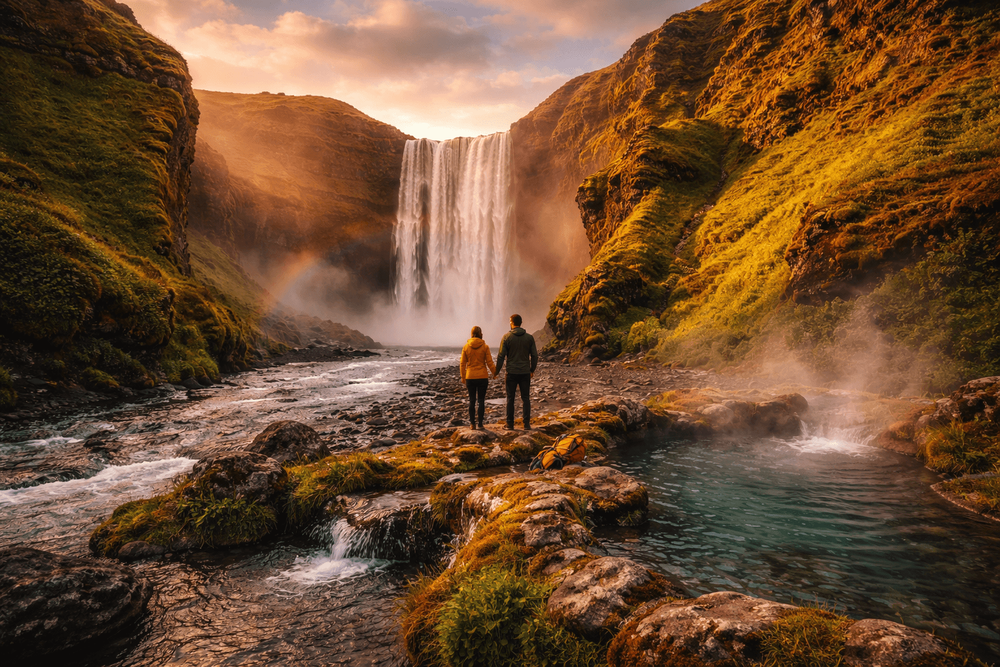
Iceland’s Secret Shoulder Season: South Coast Waterfalls, Hot Springs and Fewer Crowds
Spring on Iceland’s South Coast means roaring waterfalls, warm pools, and fewer crowds. Use this 5–7 day shoulder-season guide for March–May routes, bases, and safety.
Trip Length
5-7 days
Best Time
March to May (shoulder season)
Mood
adventure
Spray drifts like cold incense as you edge behind a lace veil of water. In March, Seljalandsfoss gives you space to linger, the roar amplified by snowmelt and the trail less busy than high summer. Later, thaw-warmed earth sends steam curling from a hillside river above Hveragerði, and a sky that still remembers winter can go dark enough for one more crackle of aurora. This is your Iceland South Coast travel guide for spring—when roads are manageable, waterfalls dramatic, and rates and crowds both ease.
Iceland South Coast travel guide: spring shoulder season
The South Coast is Iceland in a single cinematic reel—volcanic black beaches, silver-edged glaciers, cliffs scored by seabirds, and farm fields ripped with old lava. In March to May, the region feels newly awake. Days stretch fast, storms ease their grip, and trailheads reappear from under ice. You can drive the curve from Selfoss to Vík and onward toward Skaftafell and the glacier lagoons without playing leapfrog with a hundred tour buses. Hotel availability opens up, and you’ll often find better value than in peak months.
Why March–May works
- Waterfalls in full voice: Spring runoff fattens Seljalandsfoss and Skógafoss, and lesser-known neighbors like Gljúfrabúi feel more theatrical.
- Manageable roads: Route 1 (the Ring Road) along the South Coast is typically clear more often than in deep winter, yet you still get moody skies and snow-dusted peaks. Always check current conditions—weather changes quickly.
- More daylight, fewer people: The shoulder season brings longer shooting windows for photographers and fewer tour groups at headline stops.
- Wildlife moments: By late April and May, puffins begin returning to sea cliffs around Dyrhólaey (access can be restricted for nesting—check locally). Lambing season animates the farm country.
- Hot water, cold air: Steaming rivers and geothermal pools feel especially satisfying when there’s still frost on the grass.
A 5–7 day route that lingers where it counts
Use Reykjavík or the Selfoss area as your soft landing, then angle east at your own pace. Here’s a framework you can scale up or down.
Day 1: Reykjavík to the geothermal south
- Pick up your car, then slip east to Hveragerði and the surrounding valleys. If trails are open, hike to the warm river above town for a first soak with views. Base overnight in Selfoss, Hveragerði, or nearby countryside guesthouses—good jump-off points with easier access to groceries and services.
Day 2: The waterfall corridor
- Trace Route 1 toward Eyjafjallajökull. Seljalandsfoss is first—bring a waterproof layer if the behind-the-falls path is open. A short walk north hides Gljúfrabúi in a mossy cleft. Continue to Skógafoss, where the base thunders and a stairway leads to high views if the steps are safe. If beach conditions are stable, catch sunset light on the basalt stacks from Reynisfjara (obey posted warnings; sneaker waves here are serious). Overnight in Vík or just west of it.
Day 3: Black sands and cliffs
- Spend a slow morning exploring Dyrhólaey’s arch viewpoint if access allows, then wander Vík’s seafront and dunes. If you’re keen for something atmospheric, the walk to the abandoned aircraft on Sólheimasandur crosses a stark swath of black sand—flat but exposed; go only in clear weather and stick to the marked path. End back in Vík.
Day 4: Skaftafell’s trails and glacier views
- East of Kirkjubæjarklaustur, Skaftafell sits under the tongues of Vatnajökull. Trails to Svartifoss (a basalt-column-framed cascade) and glacier outlooks open progressively through spring; microspikes can help early in the season if paths are icy. Consider a guided glacier walk from licensed operators if conditions allow—this is not a place to freelance. Overnight near Skaftafell or continue to the glacier lagoons.
Day 5: Jökulsárlón and Diamond Beach
- Icebergs drift and tilt in the lagoon, sometimes backlit by soft spring sun. Across the road, polished black sand scatters with ice fragments like cut glass. Give yourself time; the scene shifts by the minute. If skies clear and night still comes early enough, keep an eye on aurora forecasts—early spring can deliver a last show. Overnight near the lagoons or loop back toward Vík.
Day 6 (optional): Highlands edge or islands, conditions permitting
- If rivers are still high and interior tracks closed (common until summer), book a local super-jeep day tour into the Þórsmörk valley to reach glacial outwashes safely, or, weather and schedules allowing, ferry to the Westman Islands for puffins and volcanic history. Both are day-dependent; have a Plan B along the coast.
Day 7: Slow return with hot spring finale
- Drift back toward Selfoss, stopping where the light is good and crowds are thin—Eljá river canyons, sea-arch overlooks, farm tracks lined with lambs. Cap the trip with a pool session at a local geothermal complex. Overnight near the airport area or Reykjavík, depending on your flight.
Where to base yourself (to find deals and easy access)
- Selfoss/Hveragerði: Handy for night-one arrivals and early starts eastward, with a cluster of supermarkets, fuel, and thermal pools. Shoulder-season lodging often prices more gently here than in midsummer.
- Hvolsvöllur/Hella: Quiet agricultural hubs that split the distance to the waterfall corridor; good if you want to sunrise-hop Seljalandsfoss and Skógafoss.
- Vík: Compact, ringed by cliffs and dunes. It’s ideal for two nights to work around weather windows at Reynisfjara and Dyrhólaey.
- Kirkjubæjarklaustur and Skaftafell area: Useful bases to reach glacier scenery early and linger late.
Getting there and getting around
- Arrival: Most international flights land at Keflavík International Airport. Pick up your rental car at the terminal area and drive roughly an hour to Reykjavík, then continue east on Route 1.
- Vehicle choice: A standard 2WD is typically enough for the main South Coast in spring when roads are clear; a 4x4 offers extra confidence if late snow or slush lingers. Highland routes and river crossings require specialized vehicles and local knowledge—go with a guide.
- Fuel and charging: Services are spaced out once you pass Selfoss. Top up when you can. EV charging exists along the corridor but plan ahead.
- Tours: If you’d rather not drive, day tours run from Reykjavík to highlights like waterfalls, black sand beaches, and the glacier lagoons—spring schedules expand closer to May.
What to expect on arrival
- Money and payments: Cards are widely accepted, even at small cafes and automated pumps. You rarely need cash.
- Food: South Coast dining skews to simple, satisfying fare: seafood stews, grilled lamb, hearty soups. Many restaurants keep shorter hours in March and April; check same-day.
- Light and weather: Expect fast-changing conditions—dramatic clouds, sudden sleet, and then a sunbreak good enough for a rainbow over Skógafoss. Days lengthen rapidly through spring; by May you’ll have long, usable daylight.
Safety and etiquette on the South Coast
- Respect the sea at Reynisfjara: Obey barriers and keep distance from the waterline. Sneaker waves here are not a photo-op risk—they are a real hazard.
- Stay on marked paths: Delicate moss and tephra fields can take years to recover from a single footprint.
- Watch cliff edges and waterfall spray zones: Surfaces are slick in spring; give yourself margin.
- Check official forecasts before driving: Weather and road advisories can change hourly. Flexibility is part of the experience.
- Hot springs common sense: Some pools are natural and unstaffed—pack out what you bring in, and test water temperatures slowly.
What this shoulder season looks like, month by month
- March: Still winter at heart, but with longer days. Northern Lights remain possible on clear, dark nights. Roads can be icy; choose bases that give you options.
- April: Thaw accelerates. Trails begin to clear at lower elevations, waterfalls roar, and lambs appear in farm fields.
- May: Long, luminous evenings. Puffins start returning to cliff colonies, and tour options increase, while peak-summer crowds are still weeks away.
The promise of spring on the South Coast
The South Coast rewards patience in every season, but spring gives you something rarer: the sense that these places are performing for themselves, not an audience. You’ll find yourself lingering longer at Skógafoss because the platform isn’t shoulder-to-shoulder, or pulling over for an unplanned half-hour just to watch a weather front paint stripes across Mýrdalsjökull. Use this Iceland South Coast travel guide as a loose script, then follow the light.
When you go now, you get the best kind of contradiction: foam and fire, ice and green, quiet and power. It’s enough to make you start checking flights before the snowmelt is gone.