
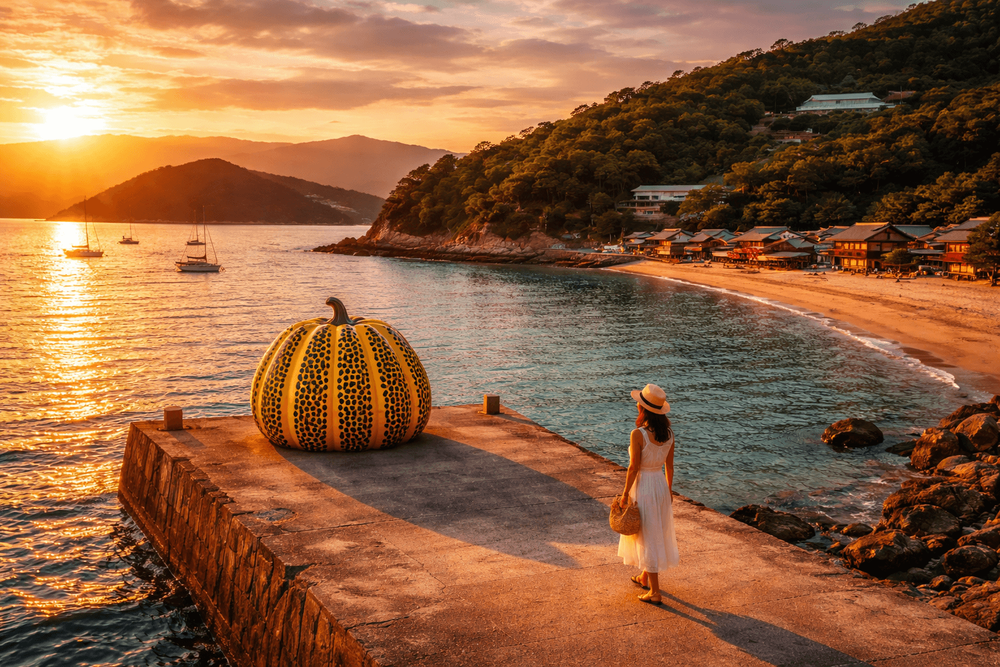
Japan’s Art Island Escape, Reframed: A Naoshima Travel Guide
Sail the Seto Inland Sea on a 5–7 day art-and-islands itinerary. This Naoshima travel guide links museum installations, ferries, design stays, and quiet harbors from Naoshima to Teshima and Inujima.
Trip Length
5-7 days
Best Time
March–November
Mood
art and design
The ferry noses past pine-tipped islets and rust-red shipyards, and then—quietly—the sea widens. Concrete planes catch the sun on a distant bluff; a dotted sculpture flashes at the pier. This is the Seto Inland Sea at its most cinematic, where art has been folded into the geography. Consider this your Naoshima travel guide to drifting between museums and sleepy harbors, design-forward stays and late-afternoon ferries that feel like moving galleries of their own.
Why these islands reward your attention
The Seto Inland Sea doesn’t rush. It edits. Everything here—light, concrete, tide—has been considered. On Naoshima, galleries are carved into hillsides, framing sky and horizon as part of the work. In neighboring Teshima and Inujima, abandoned sites and humble village streets host installations that make the islands themselves the medium. The result is a kind of slow choreography: you move between ports and pavilions, with the sea as your metronome.
Naoshima travel guide: The art archipelago in 5–7 days
Use this outline as a template and flex the order with ferry timetables. Leave room for detours; the best pieces reveal themselves when you’re not sprinting to the next line on the map.
Day 1–2: Naoshima
- Morning arrivals drop you in a modest port town where bikes hum past seaweed-drying racks. Start high and quiet: a hilltop museum built largely underground turns daylight into a collaborator, giving iconic works a meditative glow. Timed reservations for headline museums are essential; secure tickets well ahead on official sites.
- Spend your afternoon at the island’s open-air coastal museum campus, where architecture, outdoor sculpture, and shoreline fold into each other. A dedicated space for a single minimalist master feels like a private conversation between steel, stone, and sea.
- The next day, move inland to Honmura’s Art House Project, where village houses have been transformed into installations—poetry coded into timber beams, light coaxed through tatami rooms. It’s art at the scale of a neighborhood, and it changes the way you walk.
Day 3: Teshima
- A short ferry leads to an island of terraced fields and soft hills. The Teshima Art Museum is less a building than a cloud fallen to earth: a thin shell, open to wind and birdsong, where water moves across the floor in silver threads. Time behaves differently here; budget at least two unhurried hours.
- Continue to small village projects scattered along the coast—storefronts that hold sound archives, or modest homes animated by light and shadow. Rent an e-bike if you can; the island’s slopes turn from work into glide.
Day 4: Inujima
- Inujima’s former copper refinery anchors one of Japan’s most compelling acts of reuse. Galleries breathe within brick kilns and chimneys, channeling light through passages that once moved heat. The surrounding Art House projects stitch contemporary works into narrow lanes, laundry flapping above you as you step in and out of rooms that recalibrate scale and silence.
- Services are limited; plan your ferry connections carefully and carry water. The island is small enough to walk end to end between sailings.
Day 5–6 (option A): Shodoshima for texture and taste
- If you’re craving a bigger canvas, Shodoshima adds landscape and craft to the portfolio. Olive groves tilt toward the sea; weathered cedar-latticed soy sauce storehouses scent the air with caramel and salt. The island has hosted art projects along its coast during Triennale years, and its villages reward wandering with notes of design in the everyday—hand-painted shop signs, wooden wharves, small shrines tucked into rock.
- With a car or local buses, trace a loop of coves and headlands. Photographers should seek the hour before sunset when the water shifts from slate to mercury.
Day 5–6 (option B): Deepen Naoshima and Teshima
- Use the extra days to return at different times of day; installations change with shifting light and tide. Revisit coastal sculpture in the early morning when the sea is glass, or bike Naoshima’s backroads to tiny beaches where anglers cast in near-silence.
Day 7: Takamatsu or Okayama city break
- Depart via Takamatsu for a gentle urban landing. Its classic strolling garden is a study in proportion, an elegant counterpoint to the islands’ stark geometries. Alternatively, route through Okayama and detour to heritage quarters where white-walled warehouses reflect in canal water. Either way, keep the sea in sight as long as you can.
Getting there
- From Tokyo or Kyoto/Osaka, take the Shinkansen to Okayama. Local trains connect to Uno Station; from Uno Port, regular ferries or passenger boats cross to Naoshima. Alternatively, ferries run from Takamatsu on Shikoku; this route pairs well with a Takamatsu overnight.
- Ferries link Naoshima with Teshima and Inujima, though not all routes connect directly every day. Treat the ferry map like a second itinerary and check timetables before you commit to lodging on different islands.
- If you’re traveling with large luggage, consider using Japan’s luggage-forwarding services between city hotels; island buses and village lanes are friendlier when your hands are free.
What to expect on arrival
- Ports are small and human-scaled. You’ll likely step straight into a compact waterfront of cafés, rental bike shops, and a visitors’ center with maps. Coin lockers are typically available; they go fast during holidays.
- Local buses circle Naoshima between the port, museum areas, and Honmura. They’re punctual and simple; drivers are used to visitors. On Teshima and Inujima, movement is on foot or by bicycle, with occasional local buses covering longer stretches on Teshima.
- Cash is practical. Some small ferries, island buses, and cafés may not accept cards. ATMs can be limited, especially after hours.
Where to stay and what to eat
- Naoshima offers a spectrum of stays: contemporary lodgings with spare lines and sea views, intimate guesthouses inside old timber homes, and a unique museum-hotel concept where galleries extend into the night. Book early; rooms on the islands are finite.
- Teshima and Inujima have fewer beds—think family-run inns and minimalist studios—so many travelers day-trip from Naoshima or Takamatsu.
- Eating follows the islands’ rhythm. Simple set lunches near ports, seasonal seafood, udon on cooler days. Don’t expect midnight dining; plan dinners around ferry schedules and museum closing times.
When to go
- March to November is the sweet spot. Spring brings clear air and camellias; early summer is luminous and green; autumn’s light turns warm and low—particularly good for architecture and outdoor works. In high summer, heat and humidity add weight to midday visits; aim for morning and late afternoon windows and take breaks by the water.
- In years when the Setouchi Triennale returns, expect additional installations and more ferry traffic across spring, summer, and autumn sessions. Whatever the year, check museum calendars—many close one day a week, often Monday.
Practicalities for art-led travel
- Reservations: Some headline museums require advance, timed-entry tickets. Others sell same-day admissions but cap numbers for a quieter experience. Always verify current policies on official websites before you go.
- Mobility: E-bikes are ideal for Teshima’s hills and Naoshima’s museum triangle. Helmets are often available with rentals. Keep an eye on the last ferry back if you’re day-tripping.
- Photography: Certain installations and museums restrict photography entirely; respect signage and staff guidance. The best souvenir here is how the spaces made you feel.
- Weather and the sea: Sudden rain showers are part of island life. Ferries typically sail on schedule but can pause during storms; build some flex into your days.
- Sustainability: These are living communities. Keep voices low in village streets, step gently around farm plots, and pack out what you bring in.
Why this itinerary matters now
Art on the Seto Inland Sea has never been louder on social feeds, but in person it’s quiet work—about light, patience, and the way a ferry ride resets your senses. Use this Naoshima travel guide to thread the highlights without crowding your days. The reward is a rare alignment: architecture that listens to the landscape, islands that set the tempo, and a journey that keeps simplifying as you go.
Ready to start sketching ferries into your calendar? Let this Naoshima travel guide be your outline, and let the sea do the rest.
Where to Stay

Quintessa Hotel Iseshima
Quintessa Hotel Iseshima is a 3-star stay in Naoshima and the Seto Inland Sea, with easy access to local sights and a guest rating of 8/10.

Kashikojima Hojoen
5-star Kashikojima Hojoen overlooks the Seto Inland Sea near Naoshima, offering scenic waterfront stays with refined rooms, on-site dining, and easy access to island attractions.

Nemu Resort Hotel Nemu
Nemu Resort Hotel Nemu is a 4-star stay in Naoshima overlooking the Seto Inland Sea, with easy access to island sights and a guest rating of 8.8/10.

Shima Spain Mura Hotel
Shima Spain Mura Hotel is a 3-star stay in Naoshima and the Seto Inland Sea, offering easy access to local attractions and a comfortable base for exploring the area, with guests rating it 8.5/10.

Shima Kanko Hotel The Classic
Shima Kanko Hotel The Classic is a 4-star stay in Naoshima overlooking the Seto Inland Sea, with easy access to island sights. It offers elegant rooms, dining, and a 9.1/10 guest rating.