
Lofoten After the Rush: Sea Eagles, Fishing Cabins and Arctic Summer Light
A softer Lofoten: sea eagles, shorefront cabins, and Arctic summer light from May to September. Plan a 5–8 day trip with slow adventures after the crowds thin.
Trip Length
5-8 days
Best Time
May to September
Mood
adventure
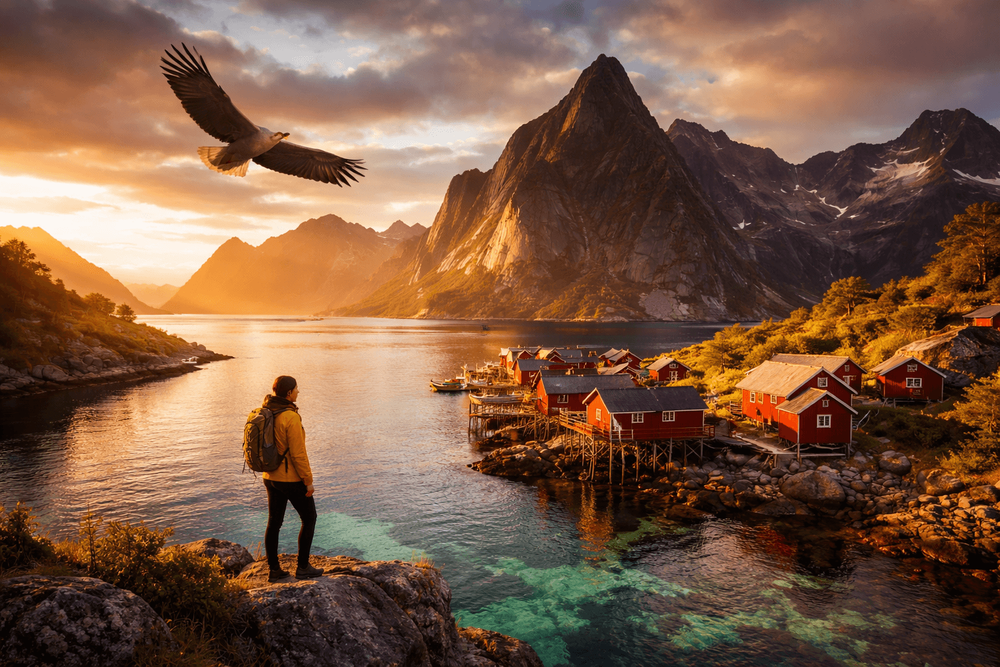
The sea eagle arrives without ceremony—just a shadow gliding over glassy water while cod racks click in the breeze and the horizon refuses to darken. This is the hour when locals pour a second cup of coffee and photographers stop checking the time. If you crave a Lofoten Islands travel guide that leans into light, wildlife, and the hush that follows peak season, consider the archipelago from late spring into early autumn, when the Arctic relaxes and the islands show their softer edge.
Your Lofoten Islands travel guide after the rush
The great surprise about Lofoten isn’t the drama of its granite walls rising straight from the sea—you’ve seen the photos. It’s the quiet that settles once the midsummer frenzy passes. In May and early June, the islands often feel newly awakened: snow lingers on ridgelines, meadows green up, and the midnight sun hovers low, casting studio-perfect light. Late August into September returns a slower tempo; daylight shortens just enough for the first aurora chances, and trailheads empty while the sea keeps its calm, pewter sheen.
This is the season to downshift. Trade checklists for a single cove you return to every evening. Let the weather write your plan: a still morning becomes a paddle; a gusty front sends you to a gallery in Henningsvær or a café with views of the harbor. The adventure remains—sea eagles, ridge walks, long inlets made for kayaks—but the islands feel more like a living community than a backdrop.
Where to stay: rorbuer and shorefront cabins
A fishing cabin is more than a place to sleep in Lofoten; it’s how you tune in. The classic rorbue—often painted red or ochre—stands on stilts over the water, with barn-gray beams, wool throws, and just enough creak in the floorboards to remind you you’re in a working harbor. Wake to gulls and the gentle knock of halyards. Step straight from your porch into a rowboat or down to a tide pool. In shoulder season, you’re more likely to snag a waterfront unit with windows that frame mountain silhouettes at midnight.
Staying in one village the entire week works beautifully here. Cabins cluster around the sheltered harbors of Austvågøy and Moskenesøya; you’ll find grocery shops, bakeries, and boat operators within an easy stroll. If you prefer to roam, book two bases—one toward Svolvær/Henningsvær, the other near Reine/Hamnøy—to minimize backtracking on the E10.
Wildlife, gently up close
Lofoten’s marquee wildlife moment is the white‑tailed sea eagle, wings broad as a door, spiraling down to lift fish from the sound with surgical precision. Local skippers run small-boat trips through narrow fjords like Trollfjord; in late spring and summer, the odds of eagle sightings are especially good. Birds dominate the rest of the cast: cormorants angling off skerries, kittiwakes stitched along cliff ledges, and—if you venture farther west by boat—the chatter of puffins around the outer islands such as Røst in season.
Closer to shore, keep an eye on the tideline. Otters work the kelp beds near quiet coves, and porpoises sometimes cut gentle arcs offshore. The key is patience: choose one inlet at golden hour, settle on a rock, and let the scene thicken on its own.
The light that rewrites your day
Above the Arctic Circle, light behaves like a companion rather than a clock. In June and July the sun swings but never lands. Mid-May can offer luminous evenings that stretch forever; by late August the sun finally sets—slowly, theatrically—leaving a drawn-out blue hour before darkness returns. Photographers will want neutral layers to stay put outside; it’s the stillness around 11 p.m. that delivers mirrorlike reflections. By September, if skies are clear and nights grow dark, hints of the aurora begin to ripple across the archipelago.
Expect your schedule to invert. Breakfasts become later, dinners drift toward the light. Many cabins have heavy curtains, but if you’re sensitive to brightness, pack an eye mask and let the rest of your habits relax.
A 5–8 day soft‑adventure plan
Think in arcs rather than checklists: one arc near Svolvær and Henningsvær, another around Reine and the western islands. Here’s a loose framework you can bend around weather and whim:
Days 1–2: Arrive and settle into a waterfront cabin. Explore Svolvær’s harbor and the art studios and galleries of Henningsvær. Choose a short, steady climb to a local viewpoint for a first survey of peaks and channels. If seas are calm, join an evening boat ride toward a narrow fjord to watch sea eagles cut over the water.
Days 3–4: Shift south and west along the E10, pausing at white-sand beaches that glow turquoise even under a gray sky. Flakstadøy and Vestvågøy hide coves perfect for a picnic or tide pooling. If the wind drops, a guided kayak on a sheltered inlet delivers silence you can hear—oystercatchers, dripping paddles, nothing else.
Days 5–6: Base near Reine or Hamnøy, where mountains stack like origami. Take an easy shoreline walk in the morning, then a ridge hike if weather and footing permit. Leave one evening for nothing more than watching the light pour through the gaps between peaks; it’s oddly riveting.
Day 7 (and 8 if you have it): Build in a true rest day. Browse a small museum tracing the cod story or linger at a pier with coffee and not much else. If ferries align and you crave birds, consider a boat trip toward the outer islands; otherwise, loop back slowly toward your first base, stopping at any beach you promised yourself you’d revisit.
Through it all, aim for fewer moves and longer pauses. In Lofoten, the in‑between moments—clouds parting over a channel, a sudden hush at midnight—carry as much charge as the headline hikes.
Practical guide: getting there, getting around, what to expect
How to get there
- By air: Regional flights connect via Bodø to the small airports at Leknes and Svolvær. Another option is to fly to Evenes (Harstad/Narvik) on the mainland and drive west onto the islands.
- By sea: Ferries run from Bodø to Moskenes (gateway to the western islands) and to ports farther north; seasonal fast boats link Bodø and Svolvær. Norway’s coastal ships also call at Svolvær and Stamsund.
- By road: The E10 threads the length of the archipelago, connecting bridges and causeways with views that argue for frequent stops.
Getting around
- A car offers the most flexibility, especially with changeable weather and impromptu photo stops. Roads can be narrow with pullouts; allow time for slow-moving traffic and give way on single-lane stretches.
- Buses connect major villages, useful for point-to-point hikes if schedules align. Cyclists will find dreamy segments, but wind and tunnels require caution.
What to expect on arrival
- Weather can change on the hour—carry layers and a windproof shell even in July. Rain here feels like a mood, then clears to silver light.
- Card payments are widely accepted. You’ll find groceries and fuel in most larger villages; supplies thin as you push west, so top up when you can.
- This is a working fishing region. Be mindful around docks and cod-drying racks, and park only in designated areas. Camping rules are specific in places; obey signage and leave no trace.
When to go for the softest season
May to September is the sweet spot for this Lofoten Islands travel guide, with different flavors of calm:
- May–June: Fresher air, snow still scalloping the peaks, wildflowers along the verges, and long, luminous nights. Crowds are lighter than in midsummer.
- July: Peak daylight and energy. If you come this month, base yourself away from the busiest villages and plan activities early or late to savor quieter hours.
- Late August–September: A quieter rhythm returns. Evenings deepen, beaches clear out, and the first aurora chances arrive if skies stay clear.
The spirit to bring—and what you’ll take home
Come ready to meet the islands halfway. Say yes to a late-night walk because the sky refuses to quit. Linger at a pier until the eagle comes back. Choose a cabin where, at 1 a.m., you can lean on the railing and hear only the tide tick against the stilts. That’s the gift of Lofoten after the rush: adventure you don’t have to chase.
When it’s time to leave, you’ll carry more than images—you’ll carry the cadence of a place that moves at the speed of weather and light. File this Lofoten Islands travel guide where you keep plans you actually make, and start checking ferry times. The sea eagle will still be here, tracing the same slow circles over the channel, waiting for your return.