
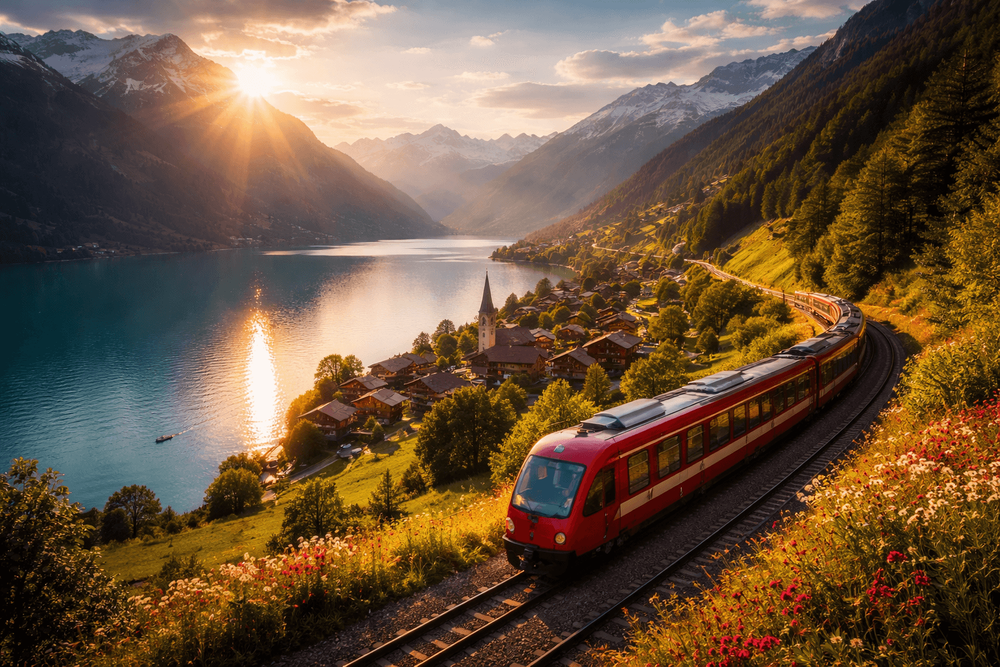
Switzerland by Scenic Train: Lakes, Mountain Villages and Smart Stopovers
Ride Switzerland’s great rail routes from lakes to high-alpine villages with smart stopovers. A polished 10–12 day loop for May–October where the journey is the story.
Trip Length
1-2 weeks
Best Time
May–October
Mood
adventure
Dawn skims a silver path across the lake as your carriage slides past terraces of vines and slate-roofed villages, the Alps sharpening with every curve. This Switzerland scenic train itinerary isn’t just a way to get from A to B; the journey is the story—wide windows framing glaciers, church spires, and water so clear you can count the stones beneath it.
Why travel Switzerland by rail
Switzerland rewards those who let the rails do the climbing. Trains here run with clockwork ease, panoramic carriages bring the landscape to your seat, and stations sit in the heart of lakeside towns and car-free mountain villages. With smart stopovers—think a night by a palm-lined promenade followed by two in a high valley—you’ll see how elegantly the country’s regions link together. Luggage services and frequent connections mean you can travel light and linger longer where the view insists.
Switzerland scenic train itinerary: 10–12 days
This route traces a north-to-south arc before curling back through the high Alps—ideal for May to October when mountain trails are open and lake life hums.
Days 1–2: Lucerne and the lakes
Arrive in Zurich and catch the short train to Lucerne, where medieval bridges meet a mirror-still lake. Spend your first afternoon walking the waterfront quays and watching paddle steamers nose toward the mountains. On day two, ride a cogwheel or cableway to a nearby summit such as Rigi or Pilatus for a preview of the massifs you’ll pierce later by rail. In Lucerne, look for a hotel facing the water; wake early and the sunrise paints alpine silhouettes across the glassy surface.
Days 3–4: Gotthard route to Ticino’s Italianate light
Take the historic Gotthard route south—by combined boat-and-train if schedules align—threading spiral tunnels and stone viaducts before the climate flips to palm trees, gelato stands, and piazzas. Base yourself in Lugano or nearby lakeside towns; this is where espresso replaces hot chocolate and dinner lingers outdoors. Use the extra day for a funicular to a viewpoint above the lake or an easy cruise between pastel waterfronts.
Days 5–6: Over the Bernina Pass to the Engadin
From Ticino, connect via Tirano and the Bernina line to the Engadin valley. The climb to the pass is an open-air geography lesson: glaciers swoop beside the track, turquoise lakes flash into view, then larch forests usher you toward St. Moritz and its surrounding villages. Consider staying in a quieter Engadin hamlet—Pontresina or Sils—where sunrise walks follow crisp streams and evening light lingers on pale peaks. Spend your second day on regional lines that branch into side valleys, or hike a well-marked path above tree line and return by train.
Days 7–8: The Glacier Express to Zermatt
Board the Glacier Express for the long, cinematic glide to Zermatt. The pace is unhurried by design: rivers braid through wide valleys, stone chapels crown meadows, and cliff-hugging towns appear and vanish with the bends. Zermatt itself is car-free: arrive to the rattle of e-buses and the muffled clip of hikers’ poles. Choose a chalet-style stay with a balcony; evenings bring a hush broken only by the creek and the faint chime of a distant clock tower. On your full day, take a cogwheel train to a high ridge for a curtain-lifting view of serrated summits, or wander the old quarter’s weathered barns.
Days 9–10: Rhône valley to Montreux, then the GoldenPass to Interlaken
Roll west along the Rhône, vineyards tilting toward Lake Geneva, and linger in Montreux for a night of Riviera ease. A lakeside hotel here sets you up for a golden-hour stroll past Belle Époque facades and sculpture-dotted promenades. Next morning, settle into the GoldenPass route from Montreux up into the hills and down to Interlaken. Windows widen; cowbells ping in the meadow-scented air at intermediate stops; peaks come and go like a slow flipbook. In Interlaken, use the remainder of the day to dip into the Jungfrau Region—trains fan out to Lauterbrunnen’s cliff-lined valley, Wengen’s sunny terraces, and Grindelwald beneath ice-fringed walls.
Days 11–12: Luzern–Interlaken Express and back to Zurich
Ride the Luzern–Interlaken Express across glacial lakes and over tidy passes to return to Lucerne, then continue to Zurich for your final night or onward flight. If time allows, pause in lakeside towns en route—compact stations make quick detours easy—and toast the loop with a glass of crisp local white.
This arc fits neatly into 10 days; add two more for longer hikes, leisurely lakeside afternoons, or a detour to a smaller valley that caught your eye from the window. It’s the rare trip where moving on feels like staying put—each transfer is another chapter of the view.
Smart stopovers: where to pause and why
- Lucerne: A launchpad with mountain access and an old-town core made for twilight walks.
- Lugano or Ascona: Swiss service with Mediterranean rhythm—cafés, palms, and late light on the water.
- Engadin villages: Air so dry it rings; early trains whisk you to trailheads and high viewpoints.
- Zermatt: Car-free calm and high-alpine railways right from the center.
- Montreux: Belle Époque swagger and vineyard-framed sunsets before the GoldenPass climb.
- Interlaken area: Handy for day trips into Wengen, Lauterbrunnen, or Grindelwald by cogwheel line.
Choose hotels that match the mood of each stopover: a lake-facing grande dame in Montreux, a timbered inn in the Engadin, a chalet with a view in Zermatt. Aim for places within walking distance of the station; arriving on foot keeps the narrative intact.
Practical planning for the rails
- Reservations: Seat reservations are mandatory on certain named panoramic trains such as the Glacier Express; others are optional but worthwhile in peak months. Regional trains generally do not require reservations and run frequently.
- Passes and tickets: A national rail pass such as the Swiss Travel Pass can simplify planning and often includes boats and many mountain lifts at a discount; the Half Fare Card reduces most fares. If you prefer spontaneity, point-to-point tickets and day passes are easy to buy on the SBB Mobile app or at station machines.
- Luggage: Station-to-station and door-to-door luggage services can forward your bags so you travel with just a daypack.
- Food on board: Many long-distance trains offer a bistro coach or at-seat service; a simple picnic of regional cheese, fruit, and bakery finds pairs well with a window seat.
- Photography: Some regional trains have windows that open in vestibules, helpful for glare-free shots. On panoramic cars with sealed windows, sit away from reflections and wear dark clothing to minimize glare.
How to get there
Fly into Zurich or Geneva; both airports sit on direct rail lines that deliver you to city centers in minutes. International travelers can also arrive by train—there are frequent connections from Milan and Paris—and connect seamlessly to the itinerary’s first leg in Lucerne or Montreux. If you’re starting in Ticino, Milan’s Malpensa Airport has rail links north into Switzerland.
Best time to visit
May to October is prime for this route. Spring brings alpine pastures alive and milder temperatures along the lakes. High summer offers long daylight hours for hikes and terrace dinners, while early autumn bathes larch forests in amber and thins the crowds. Panorama trains run year-round on many sections, but some seasonal services and high trails are most reliable from late June through September.
What to expect on arrival
Stations are compact, well-signed, and refreshingly intuitive: platforms are marked by carriage position, departure boards update by the minute, and connections are timed to the schedule’s tight choreography. You’ll find lockers, food halls, and kiosks for last-minute snacks. Trains glide in on time; doors open wide and low, with luggage racks at carriage ends and overhead shelves for smaller bags. Quiet cars offer hushed compartments if you want to let the scenery do the speaking.
Make the journey the destination
A polished Switzerland scenic train itinerary turns transfers into highlights and hotels into chapters—lake, peak, vineyard, valley. It’s an adventure measured in vistas rather than miles, the kind that leaves you paging back through your photos and tracing lines on the map long after you’ve rolled into the last station. Start building your loop and claim a window seat; the Alps are waiting just beyond the glass.