
The Road to the Red Center’s Best Stays: Sleeping Well in Australia’s Outback Heart
Design-forward camps, stargazing decks, and sunrise walks define a 5–7 day Red Centre route through Uluru, Kings Canyon, and the West MacDonnell Ranges—comfort first, always.
Trip Length
5-7 days
Best Time
May to September
Mood
adventure
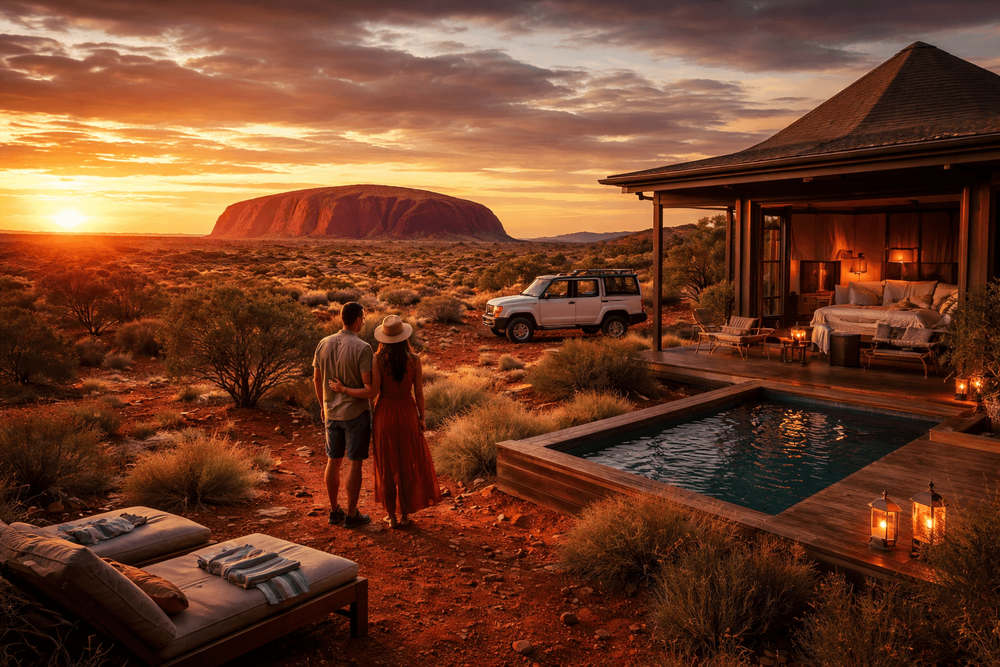
At first light, the rock exhales color—plum to ember—while a cool wind slips through spinifex and your kettle sings on a private deck. From the comfort of a canvas suite facing the dunes, this is Uluru luxury accommodation at its most elemental: the sky is your ceiling, silence your concierge, and a sunrise walk starts the day like a quiet ritual.
Why design-forward stays belong in the Red Centre
Out here, design isn’t an overlay—it’s a survival skill refined into elegance. Architecture leans low to the land, built in warm stone, textured timber, and taut canvas that catch the desert light. Interiors are spare, tactile, and purposeful: a place to laze in the shade at midday and step into the stars by night. The best properties orient living spaces toward horizons rather than screens, with beds positioned for dawn views and outdoor lounges angled to the Milky Way. Sustainability isn’t a credential but a baseline—solar power is common, water is handled thoughtfully, and menus read like a love letter to native herbs and arid-zone produce.
This is the Red Centre for design lovers: luxe camps that let you feel the desert without wearing it, and quiet comfort that turns simple moments—tea at twilight, the first magpie-lark call—into memory anchors.
Where to base yourself: Uluru luxury accommodation
Your gateway is the resort township near Uluru–Kata Tjuta National Park. High-end tented pavilions and desert lodges spread across the dunes, buffered from one another so the soundtrack is wind, distant birdlife, and the occasional dingo pad on sand. Expect generous king beds with natural-fiber linens, private decks with daybeds or plunge tubs, and indoor-outdoor showers that make the most of dry air and wild light. Many stays include stargazing sessions with high-powered scopes and guides who can point out the emu in the sky alongside classical constellations.
The rhythm here rewards early starts. Arrange a guided base walk to learn about Country from Traditional Owners’ perspectives, or roll out before dawn for one of several sanctioned sunrise viewpoints. Return to a long breakfast, then retreat to shade while the desert turns reflective. Late afternoon is for the ochre glow—picnic hampers find their moment, and desert dining experiences set elegant tables under a canopy of stars.
A note on respect: parts of the park are culturally sensitive, and photography is restricted in places. Buy your park pass in advance or at the gate, stay on marked paths, and let your guides set the tone.
Kings Canyon: sleep to the rim’s rhythm—without roughing it
Several hours by road from Uluru, the canyon rises in stepped sandstone like a monument built by water and time. Accommodation here has grown up from simple motel blocks to design-forward eco-cabins and elevated safari tents. The best options bring the canyon into the room: private decks framing ghost gums, thoughtfully lit pathways to reduce night glare, and star domes that make midnight astronomy an under-the-duvet sport.
Come for sunrise on the rim walk or a gentler floor stroll beneath beehive formations. Spend the heat of the day horizontal with a book and a cold drink, then return for late light when the walls turn coppery and the shadows lengthen. Dining skews hearty and produce-driven—think flame-grilled proteins scented with native spices and crisp salads that earn their place. Evenings end fireside, where you can feel the temperature drop in real time, the way deserts do.
West MacDonnell Ranges: desert modernism and deep-sky nights
West of Alice Springs, ranges strike linear silhouettes, slice after slice, with waterholes tucked in their seams. Here you’ll find intimate lodges and glamping sites that riff on desert modernism—clean lines, raw materials, generous eaves—set discreetly among mulga and red earth. Days start cool and luminous. Walk through narrow gaps, trace creek beds to permanent pools, and sit in the shade while zebra finches stitch the air with sound. Return to camp for a long lunch and a nap, then head out again when the stone cools and the light swings toward gold.
Stargazing here is almost confrontational in its clarity. Properties often dim exterior lighting and offer portable telescopes, but you won’t need more than your eyes. If you’ve never watched a satellite drift through the Milky Way or seen the Coal Sack by naked eye, you will.
The ideal 5–7 day route
Use this as a scaffold and slot in guided experiences as you like:
- Days 1–3: Fly into Ayers Rock/Connellan Airport (AYQ). Check into your Uluru base and focus on slow immersion—sunrise and sunset viewpoints, guided cultural walks, and a long afternoon by the pool or in the shade. Book one night of stargazing and one open-air dinner.
- Days 4–5: Drive to Kings Canyon. Choose a desert-luxe stay that puts you close to trailheads but far from engine noise. Walk at dawn, rest at midday, and linger outside after dark.
- Days 6–7: Continue to the West MacDonnell Ranges or route via Alice Springs. Hike to waterholes in the cool, siesta in the heat, and end with a final night of sky-watching from your deck. Fly out of Alice Springs (ASP) or return to AYQ, depending on your loop.
Prefer not to drive? Regional tour operators run multiday itineraries that connect these anchors with comfortable vehicles and guides; many design-forward stays partner with them for door-to-door simplicity.
Practicalities: getting there, permits, and what to expect
- Getting there: The two main gateways are Ayers Rock/Connellan Airport (AYQ), a short drive from the resort township near Uluru–Kata Tjuta National Park, and Alice Springs Airport (ASP), the springboard for the West MacDonnell Ranges. Major Australian cities offer regular flights to one or both. Car hire is available at both airports; book ahead in peak months.
- Driving: The region’s primary highways are sealed and straightforward, with long stretches between services. Carry water, know your fuel range, and avoid driving at dawn and dusk when wildlife is active. Some connecting roads are unsealed and may require a permit; a 4WD is recommended for those sections, and weather can change conditions quickly. If you’d prefer to stay on sealed routes, there are alternatives—you’ll simply spend more time on the road.
- Permits and passes: A park pass is required to visit Uluru–Kata Tjuta. Other parks may have separate permits or bookable campsites; your accommodation or tour operator can advise. Respect signage around cultural sites and follow ranger guidance.
- On arrival: Expect cool, dry air and a big sky that recalibrates your sense of space. Check-in is usually midafternoon; mornings are prized for activities, and many properties structure days around dawn and dusk. Staff will outline safety basics—hydration, sun protection, and where walking is appropriate.
- Weather and what it means for comfort: From May to September, mornings and nights are chilly, often near the edge of frost in some pockets, while midday warms to walking-friendly temperatures. Luxe camps are prepared with quality linens, heating as needed, and outdoor fire pits or lounges for night sky sessions. Flies can be present in warmer shoulder periods; properties typically offer nets or practical workarounds during peak times.
How to choose the right stay
- Look for orientation to views rather than roadways—dune-facing decks and low, horizontal lines signal quiet.
- Prioritize properties that limit light pollution at night and offer guided astronomy; the difference in stargazing quality is dramatic.
- If sunrise walks are your priority, aim for stays with early breakfast options and proximity to trailheads.
- For hot middays, shaded pools, deep verandas, or outdoor lounges make all the difference.
- Ask about cultural programming led by Traditional Owners—this adds depth to every vista you’ll photograph.
Best season for this trip
May to September aligns with clear air, crisp nights, and walkable midday temperatures—prime for stargazing and sunrise hikes without crowding your days with siestas. It’s also the period when Uluru luxury accommodation tends to book out far in advance; secure key nights early, especially around public holidays and school breaks.
The case for staying longer
The distances here teach patience. Give the Red Centre six nights and it will slow your pulse: two or three by the rock, a pause beside the canyon, and another pair under the long line of the West Macs. Add an extra night and trade a checklist drive for a nap in the shade and a second sunrise—the difference between passing through and truly arriving.
Planning starts now
This landscape rewards those who lean into rhythm: rise early, rest at noon, and spend your evenings under a chandelier of stars. With the right base, comfort sharpens every sense. Start by locking in your Uluru luxury accommodation, then sketch the arc—canyon, ranges, sky—and let the desert do the rest.
Where to Stay

Kings Canyon Resort
Kings Canyon Resort is a 4-star base near Kings Canyon in the Uluru, Kings Canyon and West MacDonnell Ranges area, with guest rooms suited for exploring the outback and a 7.5/10 rating from visitors.