
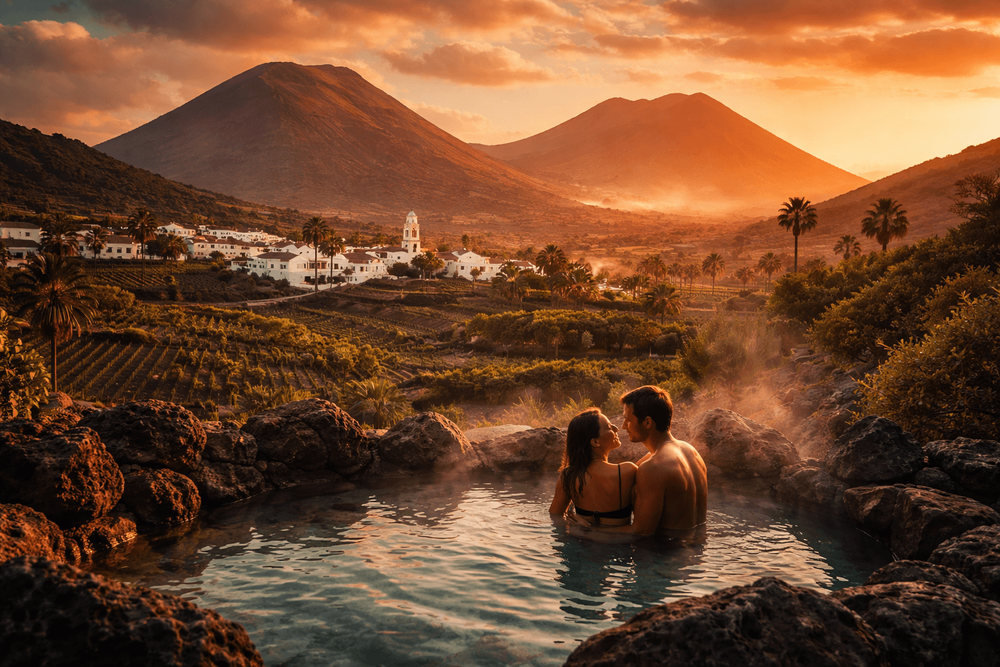
Under the Volcanoes: Hot Springs, Wine and Old-World Villages in the Canary Island of Lanzarote
Volcanic Lanzarote is made for winter sun: lava landscapes, ash-grown vineyards, thermal rituals, and whitewashed villages—mapped here in a 5–7 day design-forward escape.
Trip Length
5-7 days
Best Time
December to April
Mood
adventure
Before the sun catches the ocean, the lava fields glow charcoal-blue and the island is all hush. In the half-light you can trace the low stone crescents cradling single vines, watch steam curl from a spa pool, and spot a whitewashed village blinking awake against a wall of extinct cones. This is winter on Lanzarote: soft light, salt air, and a geology lesson you can taste and soak in. Consider this your Lanzarote travel guide to the island’s volcanic microclimates, design-forward stays, and slow, generous days between vines and sea.
The island the volcanoes built
Lanzarote wears its geology on the surface. Cones shoulder the horizon; fields of rippled lava harden into sculpture. Trade winds rake the north and skim cloud across the Famara cliffs, while the south often basks in clearer skies. That contrast is your opportunity: one hour you’re skimming tide pools in the northeast, the next you’re nursing a glass of local white among lunar vines.
The architecture sets the tone for a design-rich escape. Low, white homes trimmed in green or blue reflect the island’s careful building codes—shaped in part by the visionary artist César Manrique—so the landscape always leads. Many contemporary villas and boutique lodgings borrow the palette: white cubes, black gravel courtyards, cactus gardens, and windows punched through lava bubbles. Add in heated pools and terraces shielded from the wind, and you have stays that feel tuned to the elements rather than fighting them.
Lanzarote travel guide: essentials for a 5–7 day winter-sun escape
- Why now: December to April brings milder temperatures, long golden mornings, and sea horizons rinsed clear by the trade winds. The light is made for photography; the heat is kind to hikers.
- Trip rhythm: Aim for 5–7 days. Split time between the south coast’s sheltered bays and the island’s interior villages to catch both microclimates.
- Where to stay: Design-forward retreats crop up across the island—think lava-stone patios, clean lines, and solar-heated pools. Choose a base near the central highlands for easy reach of vineyards and volcanoes, then finish on the coast for swims and spa time.
- Getting a feel: The island is compact, its roads well-kept. You can cross from north to south in a leisurely morning, detouring for viewpoints and coffee in whitewashed plazas.
Vineyards in ash: La Geria’s moonlit agriculture
Wine here grows in defiance of the landscape—and because of it. After eruptions blanketed the island in black ash, farmers discovered that volcanic picón captures scant moisture and shields roots from wind. The solution became an icon: wide, hand-dug pits, each hiding a single vine, protected by half-moon walls of dark stone. Drive through La Geria and it’s like cruising a terrestrial galaxy, each vine its own cratered planet.
Tastings tend to be unfussy affairs in low-slung rooms that smell faintly of stone and citrus. Expect crisp, mineral-driven whites (Malvasía Volcánica is the headline grape) and delicate dessert wines, all with a saline note that feels like sea spray on the palate. Go early for the best light across the lava, and always leave time to wander a few rows, tracing how those stone “zocos” hold back the wind.
Thermal heat, tidal pools, and watery rituals
Lanzarote isn’t an island of steaming, riverside hot springs. Its heat moves differently—stored beneath your feet and teased to the surface in flashes. In the volcanic heartland, rangers demonstrate how the ground still breathes, channeling underground heat into sudden whooshes of steam. It’s a reminder that the island’s thermal energy is very real, even if your soaking happens elsewhere.
Along the coast, wellness centers lean into thalassotherapy and thermal circuits—seawater pools, saunas, contrast showers—often warmed and sheltered to make winter afternoons feel like a private summer. For something wilder, the northeast wraps around a chain of lava-rock tidal pools that calm with the ebb. On a low-tide day they become natural ocean baths. As always with Atlantic edges, read the water with respect and follow local guidance.
Design-forward Lanzarote: where nature frames the view
Follow the island’s design language and you’ll keep bumping into Manrique’s legacy: art folded into geology, viewpoints that look like they grew from the cliff, and interiors that feel pulled from lava tubes. Daylight falls just-so in spaces set inside volcanic bubbles; a window becomes a painting of sea and crater; cactus are curated like sculpture.
Even if you’re staying in a modern villa or a minimalist guesthouse, the spirit is the same—nothing tall, nothing brash, everything angled toward the view. Seek out galleries that celebrate local craft, stop for coffee in courtyards draped with bougainvillea, and save at least one late afternoon for a coastal lookout where the sun scorches the horizon into copper.
Villages that invite lingering
Old-world villages pop up like punctuation marks across the lava. The former capital, Teguise, gathers around pale stone plazas and thick-walled homes—an easy place to linger over a long lunch and browse studios selling ceramics and island linens. Yaiza, on the approach to the volcanic park, is spotless and quiet, its white facades glowing against the dark soil. Haría unfurls in a greener valley, where palm trees hush the wind and workshops open onto narrow lanes.
Aim to visit in the early evening, when the day-trippers slide away and the squares belong to locals. Order grilled fish, bright with island citrus and herbs, or a plate of wrinkled potatoes with a spoon of peppery mojo. There’s no rush here; the island rewards patience.
Adventure, measured in lava and wind
If you crave movement, the island indulges you. Hike the rim of a pale caldera and look down into a bowl of fossilized ash. Meander on waymarked trails skirting younger cones where lichens draw silver maps across the black. On the west coast, Atlantic rollers court surfers—lessons are easy to organize along the long arc of sand below the northern cliffs. Cyclists find quiet roads and volcanic gradients that keep routes interesting without turning them into ordeals. Underwater, divers fin through reefs of lava boulders where angel sharks may ghost by in season.
Winter amplifies the drama. The wind can rise and fall, shifting light in minutes. Pack for layers and trust that a sheltered cove or a leeward terrace is never far away.
Practicalities: getting there, and what to expect on arrival
- Arrival: Fly into César Manrique–Lanzarote Airport (ACE), connected to mainland Spain and major European hubs. Ferries link Lanzarote with neighboring islands; the hop from Fuerteventura is especially frequent.
- On the ground: Car hire is straightforward at the airport. Roads are smooth and well signed; driving is on the right. Public buses knit together the main towns, but a car unlocks quiet lookout points, vineyards, and trailheads.
- Money and language: The euro is standard; cards are widely accepted. Spanish is the official language; you’ll hear plenty of English and German in resort areas.
- Weather reality: Microclimates matter. The north can run cooler and windier; the south often feels gentler. Occasionally a calima blows Saharan dust across the island for a day or two, softening views and warming the air—then the sky scrubs clear again.
A 5–7 day plan for slow winter sun
- Day 1: Land, collect your car, and find the sea. Swim if the water calls; warm up in a spa circuit if it doesn’t. Sunset on a coastal promenade sets the tone.
- Day 2: Volcanic heartland. Join park-run routes across the lava fields, then walk a crater rim just beyond the boundaries where independent hiking is allowed. Dinner in a village on the edge of the lava.
- Day 3: La Geria. Taste crisp whites and late-harvest sweets; linger for a vineyard lunch. Drive back via viewpoints where the ocean cuts a cobalt line against the black.
- Day 4: North coast. Explore lava-tube architecture and viewpoints that cantilever over cliffs. Time your visit to the tidal pools for a safe, low-tide dip.
- Day 5: Villages and craft. Wander Teguise in the morning and the palm valley in the afternoon. Pick up ceramics or a handwoven basket; sip coffee in a shaded courtyard.
- Day 6: Ocean day. Surf lessons along the northern sands or a guided dive in sheltered water. Recovery in a design-forward stay with a heated pool.
- Day 7: South for calm coves and long beach walks among dunes. End with seafood and an island white as the sun slides off the edge of the map.
Why this Lanzarote travel guide works in winter
Short days back home meet long lunches here. The architecture flirts with the wind but keeps it at bay. Vineyards look like modern art. And the island’s quiet strength—lava, salt, cactus, white walls against black soil—feels like a reset. Book the flight, choose a stay that frames the landscape rather than masking it, and let the volcanoes set your pace.
Where to Stay

Hotel Lancelot
Hotel Lancelot is a 3-star Lanzarote stay with a 9/10 guest rating, offering a convenient base for exploring the island and comfortable accommodations for travelers seeking a well-rated, practical hotel.

Hipotels La Geria
4-star Hipotels La Geria in Lanzarote offers easy access to the island’s beaches and attractions, with comfortable rooms, a pool, and facilities for a relaxed stay. Guest rating: 8.3/10.

Hipotels Natura Palace Adults Only
Adults-only 4-star hotel in Lanzarote with a 9.1 guest rating, Hipotels Natura Palace offers a peaceful stay with sea views, pools, a spa, and easy access to the island’s coastal attractions.

Dreams Lanzarote Playa Dorada Resort & Spa
Beachfront 4-star resort in Lanzarote with direct access to Playa Dorada, several pools, spa, fitness facilities, and family-friendly amenities. It offers easy access to the promenade and nearby shops, with an 8.9/10 guest rating.

Hotel Lava Beach
Hotel Lava Beach is a 5-star Lanzarote hotel with a 9.4/10 guest rating, offering a modern beachside stay with easy access to the island’s coastal scenery and amenities for a relaxed holiday.