
Where Rivers Meet: Boat Safaris and Night Drives on the Chobe–Okavango Border
Pair Chobe’s golden-hour riverboats with Okavango mokoro nights. Solar-powered camps, night drives, and conservation-led luxury across the Botswana–Zimbabwe border.
Trip Length
5–8 days
Best Time
May–October (dry season)
Mood
Wildlife / Luxury
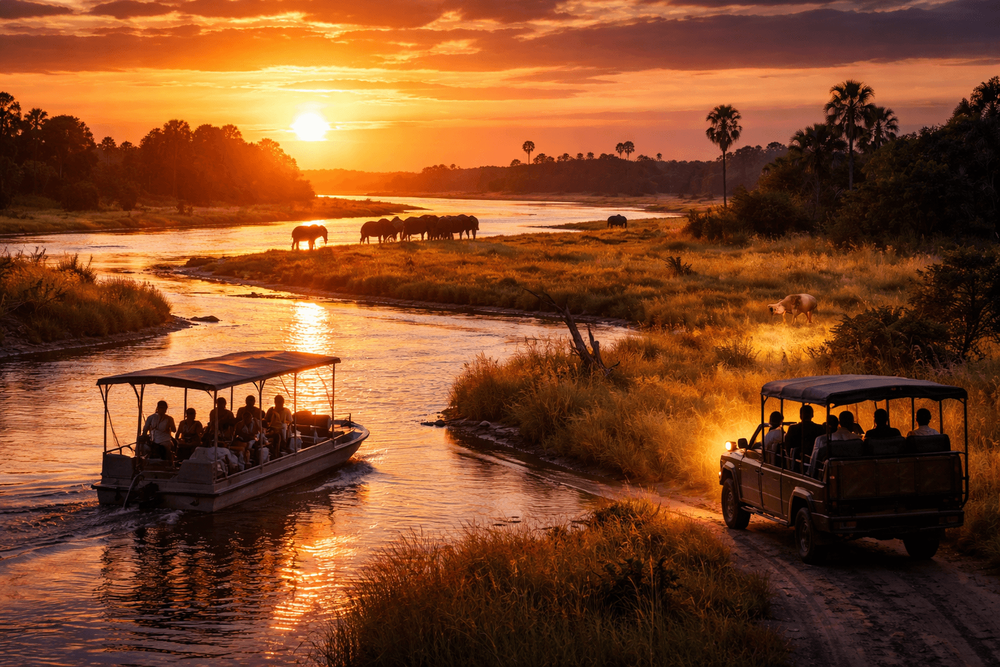
The river is glass at last light, stained copper by Kalahari dust. A tusked silhouette tests the current, then steps through with deliberate grace. Your skiff drifts, engine silent, while fish eagles call from acacia snags and a raft of hippo murmurs like distant thunder. This is the hour a Chobe safari Botswana promises: waterline eye level, the borderlands of two countries trailing gold, wildlife arriving in waves for one more drink before the stars take over.
Chobe safari Botswana: Rivers, Reeds, and Night Skies
Here, on the seam where Botswana, Zimbabwe, and their neighbors brush shoulders near Kazungula, two distinct safaris complement each other. Chobe’s riverfront channels daytime by the clock: elephants and buffalo on the move as the dry season concentrates life along the banks. The Okavango Delta rewrites the rhythm with mokoro stillness, reed-fringed islands, and nights tuned to owl calls and the low purr of leopard far off. Pairing the two gives you both vantage points—big-water drama and intimate floodplains—without rushing either.
The River: Boat Safaris on the Chobe Front
Chobe is a water story first. Morning light finds crocodiles warming on sandbars and malachite kingfishers firing neon across the reeds. By late afternoon, the park’s famed elephant herds step from scrub to shoreline, family units fanning out to bathe and spar in the shallows. From a low-slung photographic boat you’re at eye level with them, the horizon wide, the angles clean. When the wind falls, reflections double everything—waterbuck in mirror image, a parade of red lechwe seeming to float.
Road drives along the Chobe Riverfront are excellent, but time on the water changes the way you see behavior. You learn to read the river: where a back channel might hide a basking python; which sandspits the skimmers patrol at dusk; when to drift, when to cut the engine and let the herds claim the scene. Guides here work these beats daily and know when the park quiets, when boats thin, and how to slide into position without pushing the animals.
The Marsh and the Moon: Mokoro Nights in the Okavango
Fly south-west and the frame tightens. The Okavango Delta is a labyrinth of channels and palm islands formed by a river that empties into sand. Mokoro polers stand at the stern and steer with long ngashi poles, whispering across lilies. You leave the engine behind. There’s the gentle rasp of reed against hull, the ping of reed frogs, the clean scent of wild sage crushed underfoot on a sandbank.
Days unfold with a patient cadence: glide at dawn, walk islands when it warms, siesta through the heat, then slip out again for sunset. On calm nights, some concessions offer simple sleep-outs on raised decks—canvas swaying, lanterns dimmed, the Milky Way laid bare. It’s an antidote to noise. The only rush is the hush before hyena whoop or the breathy cough of a lion on patrol somewhere in the mopane.
After Dark: Night Drives and the Delta’s Second Shift
Where regulations allow in private concessions, night drives reveal a different map. A slow, responsible sweep of the spotlight shows eyeshine first: civet shuffling with its banded tail, springhares arcing like miniature kangaroos, a wide-faced bushbaby frozen between leaps. Owls take fenceposts of air—spotted eagle-owls, pearl-spotted owlets—while the grasses whisper with the small business of rodents and insects. Predators own the hours after midnight; you might pick up a leopard’s sauntering tracks in the morning sand, then backtrack to where the story began under starlight.
The ethical lodges keep the beam moving, avoid prolonged views that disturb hunting, and guide vehicles with a soft touch on fragile terrain. It’s a reminder that the privilege of seeing the nocturnal shift comes with responsibility.
Conservation in Practice: Solar Camps and Local Voices
A Chobe safari Botswana can be indulgent without being careless. On the ground, that balance looks like solar fields tucked behind thornbush, battery banks storing daylight for your lamps and fans, and kitchens that trade diesel for induction the moment the power budget allows. Water purification is handled on-site; grey water is filtered and returned to sandy soils through reedbeds; walkways float above floodplains instead of carving through them.
You’ll hear it from the people who live here. Guides talk about elephant corridors the way city dwellers talk about traffic—where herds traditionally cross, which routes are pinched by farms, how seasonal pans pull animals off the river. Community conservancies and private concessions funnel fees into anti-poaching patrols, track-based monitoring, and scholarships for trainee guides. None of it is glossy; all of it matters. If you want your stay to count, ask your camp manager where your bed-night levy goes. The best answers are specific: ranger rations, fuel for patrol boats, junior trackers apprenticed to senior guides.
A 5–8 Day Route at the Border of Two Worlds
Think of your days in two chapters—river first, then reeds.
- Day 1: Arrive via Victoria Falls (Zimbabwe) or Kasane (Botswana). If coming through Zimbabwe, the road to the Botswana border is short; immigration formalities are straightforward, though requirements change, so check ahead. Settle into a river-facing base near Kasane and board a late-afternoon boat for your first encounter with the Chobe.
- Day 2: Dawn game drive along the riverfront when cats patrol and sable antelope step into view if you’re lucky. After brunch, rest. Return to the water for a long, golden-hour cruise; drift with elephants and watch carmine bee-eaters hawk for insects above their sandbank burrows.
- Day 3: One more Chobe morning—perhaps a photographic boat with swiveling chairs or a slow, bird-focused skim into backwaters. After lunch, transfer to the airstrip for a light-aircraft hop into an Okavango concession.
- Days 4–6: Mokoro mornings, guided island walks, and a night drive where permitted. Sleep-out option on one night if conditions are right. Expect your pace to downshift; the Delta rewards lingering.
- Days 7–8 (if adding time): Move deeper into the channels for a second camp with a different setting—more floodplain or more woodland—or loop back toward Maun for a final night and onward flight.
The contrast is the point: river herds marching to water, then Delta shadow-play in a quieter theater. It’s one safari in two dialects.
Practicalities: Getting There, When to Go, What to Expect
- Best time: May to October is the dry season—clear skies, receding floodplains that concentrate wildlife along the Chobe, and reliable mokoro channels in much of the Okavango. Early winter brings crisp mornings; late winter sharpens dust and light.
- Gateways: Fly into Victoria Falls (VFA) or Kasane (BBK) for the Chobe sector. Maun (MUB) is the classic hub for the Okavango. Road transfers connect VFA to Kasane via the border post near Kazungula; charter flights link Kasane or Maun to Delta airstrips.
- Borders and docs: You’re crossing international lines; fees and visas vary by nationality. Confirm current requirements before you travel and allow time at the border.
- Planes and bags: Light aircraft to the Delta have strict weight limits and usually require soft-sided luggage. Your operator will brief you; follow their guidance to keep the planes safe and the logistics smooth.
- On arrival: Expect open vehicles, early starts, long midday breaks, and the soft grit of Kalahari sand everywhere. Boat departures chase light and tides; mokoro outings follow wind and channel depth. If you’re a photographer, bring a beanbag and a lens cloth—the river mists and Delta spray are part of the story.
- Health and safety: This is a malaria area; speak with your medical provider well before departure. Camps provide drinking water and radio-linked safety protocols; night movements are always escorted.
Where You’ll Sleep: Low Impact, High Comfort
Concession lodges along this border region have refined the art of light-footprint luxury. Think canvas-and-timber suites on raised decks, ceiling fans and shady verandas instead of always-on air con, plunge pools fed by filtered water, and menus that lean seasonal and local. In the Delta, many operations shift to solar for almost everything short of rare backup needs, and you’ll see charging stations humming by midday. On the Chobe side, riverfront bases offer prime boat access and shaded hides; inland, small tented camps trade immediate waterfront views for quieter tracks and night-drive access on private land.
The people make the stay. River skippers who grew up fishing these channels have a sixth sense for current and light. Polers read ripples like road signs. Trackers know which fresh print is worth following and which is a wild goose chase. Ask questions—they’ll talk you through decision-making in real time, and the safari becomes collaborative rather than passively observed.
Why This Pairing Works Now
Water is the common thread. When the Okavango’s flood arrives from Angola, channels expand and lilies flower; when Chobe’s levels drop in late dry season, the river becomes a magnet. Linking the two lets you trace how animals navigate a landscape stitched by water and sand. It also supports the model that keeps these places wild: small camps on private concessions, powered by sun and guided by people who know each back channel and island by heart.
If you’re tuning your plans to a window between May and October, this is the itinerary that earns every early wake-up. A Chobe safari Botswana at dusk, a mokoro glide under a sky that feels close enough to touch, a night drive that teaches you to listen—all threaded across a border where rivers meet and the map shifts from blue to green. Block the dates; the river will keep its appointment.