
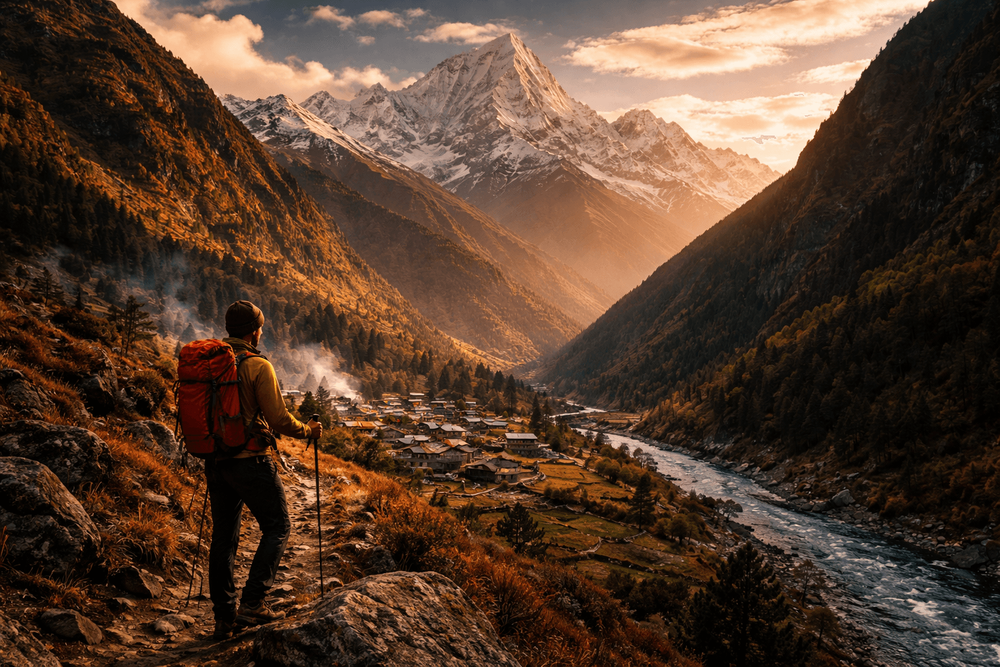
Nepal Off the Beaten Path: Remote Valleys, Hidden Treks & Authentic Encounters
Far from Everest’s queues, discover Dolpo’s Bon monasteries, Humla’s skywide valleys, Kanchenjunga’s silent flanks, and quiet Terai sanctuaries—Nepal unfiltered.
Mood
Remote Adventure
At dawn in Dolpo, juniper smoke threads through cobalt air as yak bells answer the river below and a butter lamp flickers in a cliff-hugging monastery. This is the hushed thrill of going off-the-beaten-path in Nepal: landscapes that feel mythic, cultures that have endured at the world’s edge, and trails where footsteps are few. For travelers who prefer valleys without crowds and conversations over checklists, Nepal’s far corners deliver the kind of revelation only remoteness can keep.
Where to Go Off-the-Beaten-Path in Nepal
Dolpo: Bon Monasteries, Turquoise Lakes, and High, Silent Country
Dolpo’s drama is stark and otherworldly—desert-bright cliffs, wind-carved canyons, and the glacial blue of Phoksundo Lake, Nepal’s deepest. Culturally, it is a stronghold of Bon, the ancient faith that predates Tibetan Buddhism, and home to centuries-old trade routes where yak caravans still ply the passes. Wildlife thrives in the austerity: blue sheep cling to shale slopes; snow leopards pad the night.
- What makes it unique: High Himalayan desert scenery, remote Bon monasteries, and one of Nepal’s most photogenic lakes.
- Difficulty: Demanding. Lower Dolpo circuits may cross 3–4 passes above 4,500 m; Upper Dolpo frequently tops 5,000 m.
- Ideal traveler: Experienced trekkers drawn to culture and solitude who are comfortable camping and long, high days.
Humla and the Limi Valley: On the Roof of the World
Far northwest, Humla feels more frontier than backcountry—raw, wide, and wilder than imagination. The Limi Valley unfurls a string of ancient stone villages set amid river willows and grain terraces, with chortens and prayer walls turning the paths into open-air shrines. On crystalline days, distant Mount Kailash sharpens on the horizon.
- What makes it unique: Intimate village life at the trans-Himalayan margin; sweeping river valleys; glimpses of Kailash.
- Difficulty: Demanding. Continuous days around 3,500–4,700 m; some camps remote from settlements.
- Ideal traveler: Expedition-minded hikers comfortable with self-sufficiency and thin air.
Rukum and the Guerrilla Trek: Living History and Magar Heartlands
Rukum, together with neighboring Rolpa and Myagdi, shelters the Guerrilla Trek—trails once walked by Maoist cadres during Nepal’s civil conflict, now reclaimed by peace and community tourism. The route weaves through rhododendron forests, terraced hillsides, and Magar villages where evenings spill out as impromptu song and millet-roasted warmth. In the high meadows of Dhorpatan, blue sheep graze beneath amphitheaters of ridgeline.
- What makes it unique: A living-history route with generous homestay hospitality; wild meadows and little-visited passes.
- Difficulty: Moderate to challenging, with rustic accommodation and occasional long days.
- Ideal traveler: Culture-curious hikers who prize meaningful encounters over amenities.
Kanchenjunga Approaches: Two Base Camps, One Vast Silence
In Nepal’s far east, the Kanchenjunga region fans into muscular valleys steeped in cloud forest, cardamom fields, and timbered hamlets of Sherpa, Limbu, and Rai heritage. Trails push to twin sanctuaries—North and South Base Camps—beneath the world’s third-highest peak. The atmosphere is one of immensity and restraint; the mountains seem close enough to hear breathing.
- What makes it unique: Twin base-camp routes with far fewer trekkers than Everest or Annapurna; rich ethnobotanical traditions.
- Difficulty: Challenging. Prolonged time above 3,500 m with significant elevation gain.
- Ideal traveler: Seasoned trekkers who relish solitude and stamina-testing days.
Mustang’s Hidden Side Valleys: Caves, Wind, and Walled Kingdoms
Mustang’s fame is justified, yet even here, the detours keep their secrets. Beyond the walled town of Lo Manthang, side valleys reach toward sky caves and cliff monasteries—Chhoser’s honeycombed cliffs, Yara’s lunar badlands, and the frescoed sanctum of Luri Gompa. The light is relentless, the wind insistent, and the culture deeply, vividly Tibetan.
- What makes it unique: Eroded canyons, cave complexes, fortified towns, and an intact high-desert culture.
- Difficulty: Moderate to challenging depending on detours; winds can be fierce.
- Ideal traveler: Trekkers drawn to history and geology who like to veer off the main corridor.
Terai’s Quiet Sanctuaries: Bardia, Shuklaphanta, and Koshi Tappu
Trade Himalayan passes for tiger grasslands. In far-west Bardia National Park, sal forest softens into riverine corridors where Bengal tigers leave dawn prints. Shuklaphanta’s vast phantas of grass hold one of the world’s largest herds of swamp deer, while Koshi Tappu in the east is a waterfowler’s reverie—ibises, jacanas, and wild water buffalo beneath an immense sky.
- What makes it unique: Lowland biodiversity without the crowds; real chances of tiger and elephant encounters.
- Difficulty: Easy to moderate; heat and humidity can be intense.
- Ideal traveler: Wildlife lovers seeking quieter alternatives to Chitwan.
Logistics: Getting There, Permits, Seasons, Timeframes
Going off-the-beaten-path in Nepal asks for forethought. These regions are remote by design; the reward is proportional to preparation.

Lonely Planet Trekking in the Nepal Himalaya 10 (Walking Guide): Mayhew, Bradley, Brown, Lindsay, Butler, Stuart
Lonely Planet Trekking in the Nepal Himalaya 10 (Walking Guide) [Mayhew, Bradley, Brown, Lindsay, Butler, Stuart] on Amazon.com. *FREE* shipping on qualifying offers. Lonely Planet Trekking in the Nep
Check Price on AmazonAccess and Gateways
- Dolpo: Fly Kathmandu–Nepalgunj, then to Juphal (officially Dolpa Airport). Weather delays are common; keep buffer days. From Juphal, classic circuits reach Phoksundo and beyond.
- Humla/Limi: Fly Kathmandu–Nepalgunj–Simikot. The Limi circuit radiates west from Simikot via Kermi and Halji before looping back.
- Rukum/Guerrilla Trek: Access by long jeep rides from Pokhara or Kathmandu via Beni, or flights to nearby airstrips when scheduled. Starting points vary—Beni, Sulichaur, or Thabang—depending on your chosen section.
- Kanchenjunga: Most travelers fly to Bhadrapur in the lowlands, then drive 8–10 hours to Taplejung/Phungling. Suketar airstrip is sporadically active; do not count on it.
- Mustang: Daily flights connect Pokhara and Jomsom (weather-dependent), or take a jeep via Beni to Kagbeni/Chhusang and onward. Upper Mustang requires additional permits (see below).
- Terai Sanctuaries: For Bardia, fly or bus to Nepalgunj, then 2–3 hours by road to the park. For Shuklaphanta, fly to Dhangadhi and drive 1.5–2 hours. For Koshi Tappu, fly to Biratnagar and drive 1–1.5 hours.
Smart staging pays off. Before a dawn hop to Simikot or Juphal, travelers often overnight at The Soaltee Westend Premier Nepalgunj (booking-url), a low-rise property with strong air-conditioning and an outdoor pool that makes the Tarai heat bearable. For eastern approaches, the contemporary Hotel Mechi Crown (booking-url) near Bhadrapur cuts the travel day and adds a crisp linen reset before the big hills. And for a splurge pre- or post-trek in Lower Mustang, Shinta Mani Mustang – A Bensley Collection (booking-url) brings high-design comfort and sublime canyon views without dulling the region’s raw edges.
Permits and Entry Requirements
Regulations evolve; a reputable, Nepal-based trekking agency will secure current paperwork and arrange a licensed guide where required.
- Restricted Areas: Upper Mustang, Upper Dolpo, Lower Dolpo, and parts of Humla/Limi fall under restricted status. Expect higher fees (often around US$500 per person for the first 10 days in Upper Mustang/Upper Dolpo; Lower Dolpo and Humla typically lower, commonly US$50–US$100 per week), minimum two trekkers, and mandatory licensed guide—processed through an agency.
- Conservation/Project Permits: Regions may require park or conservation permits such as Shey-Phoksundo National Park (Dolpo), Annapurna Conservation Area (Mustang), or Kanchenjunga Conservation Area.
- TIMS and Guides: Many trekking areas now require a TIMS card and a licensed guide for foreign trekkers. Agencies coordinate both.
- Wildlife Reserves: National parks and reserves in the Terai issue entry permits at gates or in advance; guided jeep/boat safaris are booked through lodges or outfitters.
If you are new to Nepal’s adventure landscape, this primer on Adventure Nepal: Treks, Peaks, Rivers & Responsible Thrills outlines the countrywide framework and planning cadence.
Best Seasons to Go
- Dolpo and Mustang: Rain-shadow magic. Late spring (May–June) and early autumn (Sept–Oct) are ideal; Dolpo can even be trekked in monsoon when other regions are drenched.
- Humla/Limi: Late spring and autumn are clearest; winters are severe and summers can be storm-prone.
- Kanchenjunga: Autumn (Oct–Nov) for crisp views; spring (Mar–May) for rhododendrons and milder temps. Monsoon brings heavy rain and landslides.
- Rukum/Guerrilla Trek: Stable in spring and autumn; winters are cold at altitude but feasible with preparation.
- Terai Sanctuaries: Cool, dry months (Oct–Feb) are pleasant; wildlife viewing peaks late dry season (Mar–May) when grass is cut and animals concentrate near water.
For a deeper, month-by-month breakdown, see our Best Time to Explore Nepal: Season-by-Season Guide for Treks, Culture & Wildlife.
How Long It Takes and Who It Suits
- Dolpo: Lower Dolpo circuits 10–14 days; Upper Dolpo 18–24+ days. Best for experienced, acclimatization-savvy trekkers.
- Humla/Limi Valley: 12–16 days. Demands fitness and tolerance for rustic camps.
- Kanchenjunga: South or North Base Camp 16–20 days; full north–south traverse 20–24 days. Best for seasoned trekkers.
- Mustang: Lower Mustang side-valley detours 8–12 days; Upper Mustang explorations 10–14 days. Good for trekkers with some high-altitude experience.
- Rukum/Guerrilla: 8–14 days depending on section. Suitable for fit hikers comfortable with homestays.
- Terai: Wildlife itineraries 3–5 days per park. Suitable for most travelers.
Those who crave high mountain drama but prefer comfortable overnights might explore Luxury Hiking Tours in Nepal: Comfortable High-Altitude Adventures for alternative pacing and lodging styles.
On-the-Ground: Where You’ll Sleep, Eat, and Connect
Accommodation: Homestays, Teahouses, and Camping
- Dolpo and Humla/Limi: Expect expedition-style camping with a full crew in Upper Dolpo and Limi; Lower Dolpo has sparse teahouses in a few villages but camping remains the norm. Nights are cold; quality sleeping bags are non-negotiable.
- Kanchenjunga: A growing network of basic teahouses provides shelter and hot meals; rooms are simple and unheated. Book through agencies to ensure reliable stops.
- Mustang: Lower Mustang offers classic teahouses; Upper Mustang ranges from simple lodges in Lo Manthang to boutique stays in Jomsom and Kagbeni.
- Rukum/Guerrilla: Community homestays define the experience—simple rooms, shared facilities, unforgettable hospitality.
- Terai: Safari lodges and tented camps range from rustic to refined, with guided activities included.
Guides and Porters
In restricted regions, licensed guides are mandatory; in others, they are strongly recommended. A local guide interprets monastery etiquette, negotiates trail changes, and opens doors to kitchens and stories. Porters make ambitious itineraries humane—adopt fair weight limits (commonly 20–25 kg per porter), provide proper clothing and footwear if needed, and tip with generosity.
Food and Water
Dal bhat powers Nepal—rice, lentils, seasonal greens, and pickles. In Dolpo and Mustang, you may be offered tsampa (roasted barley) and salty butter tea; in Rukum, earthy millet rotis; in the east, cardamom-scented curries. Carry a reliable water treatment method (filter + chemical backup) and a wide-mouth bottle or bladder. In camping regions, outfitters boil and treat water; teahouses sell bottled water but the environmental cost is high—refilling and treating is better.

Sawyer Products Squeeze Water Filtration System, Cnoc ...
View on AmazonMoney and Connectivity
Remote trails are cash economies. Bring enough Nepali rupees for the entire trek plus a contingency. ATMs are limited to gateway towns; card payments are rare outside safari lodges and upscale Mustang properties. Local SIMs (NTC, Ncell) are patchy; in Dolpo and Humla, expect full digital detox. Solar charging is a lifesaver—pack a panel or a high-capacity power bank.
Health, Safety, and Altitude
- Altitude: Build in acclimatization. Watch for headache, nausea, loss of appetite—early signs of Acute Mountain Sickness. Descend if symptoms worsen; no summit is worth a helicopter. Discuss acetazolamide with your physician before travel.
- Evacuation and Clinics: Remote health posts exist but are limited. Comprehensive travel insurance that covers high-altitude trekking and helicopter evacuation is essential. Consider carrying a satellite communicator for reliable SOS in Dolpo and Humla.
- Trail Hazards: Landslides, ice on shaded traverses, afternoon winds in Mustang, and monsoon-swollen streams in the east are all seasonal realities. Start early; consult locals on river crossings.

Garmin inReach Mini 2, Lightweight and Compact Satellite Communicator, Hiking Handheld, Orange - 010-02602-00
Home is closer than you think with inReach® Mini 2. This <strong>compact satellite communicator adds peace of mind to your adventures without adding weight to your pack</strong>. (Some jurisdictions r
Check Price on AmazonFor field-tested packing advice and cultural basics, our Top Travel Tips for Nepal: Practical, Safe, and Responsible Advice for First-Time Visitors is a useful pre-departure check.
Travel Lightly, Travel Wisely: Respect and Preparation
Cultural Etiquette
- Monasteries and Mani Walls: Walk clockwise around shrines and prayer walls; spin prayer wheels clockwise. Remove hats and shoes before entering sacred spaces.
- Photography: Always ask before photographing people, monks, or rituals; some monasteries prohibit images inside.
- Modesty and Conduct: Dress conservatively in villages; avoid public displays of affection. Do not sit with your feet pointing at shrines or elders; do not touch children’s heads.
- Bon and Buddhist Rituals: Offerings are voluntary; small notes placed discreetly are appreciated. Learn a few greetings—namaste in Nepali; tashi delek in Tibetan communities.
Low-Impact Principles
- Pack In, Pack Out: Carry a trash bag; avoid single-use plastics. Refill and treat water instead of buying bottles.
- Fuel and Fires: Use gas for cooking on camping treks; never cut live wood. Keep soaps bio-degradable and away from water sources.
- Wildlife: Maintain distance, especially around nesting birds and big mammals. In the Terai, follow your naturalist’s guidance strictly.
- Sensitive Sites: Cave complexes and murals are fragile—no touching, no leaning, no drones without explicit permits.
Supporting Local Economies
- Hire Local: Choose agencies that employ local guides and porters from the region you’re visiting.
- Stay and Eat Local: Opt for community homestays where available; order local dishes that rely on regional produce.
- Buy Direct: Handwoven belts, yak-wool shawls, and carved amulets are best purchased from makers, with bargaining kept friendly and fair.
Essential Gear
- Footwear: Broken-in trekking boots, camp shoes.
- Sleep System: -15°C (5°F) or warmer sleeping bag for high camps; insulated pad.
- Layers: Merino base layers, windproof shell, down jacket, warm hat and gloves.
- Sun and Wind: Glacier sunglasses, buff, brimmed hat, high-SPF sunscreen, lip balm.
- Navigation and Safety: Paper maps, headlamp, first-aid kit, water filter, satellite messenger in remote regions.
- Extras: Trekking poles, dry bags, portable power bank/solar panel, snacks for long hauls.
Risk Management
- Build Buffers: Weather delays into Juphal, Simikot, and Jomsom are common. Pad both ends of your itinerary.
- Stay Flexible: Landslides or local festivals can reroute plans; a good guide reads the landscape and community rhythms.
- Vet Your Operator: Look for clear evacuation protocols, medically trained staff, and transparent porter welfare policies.
- Know Your Limits: Remote days magnify small issues. If altitude or fatigue builds, shorten the stage or add a rest day.
Those ready to lean into effort and awe will find that going off-the-beaten-path in Nepal offers more than remote panoramas. In Dolpo’s wind and Mustang’s light, in the cardamom shade of Kanchenjunga and the gold grass of Bardia, the country reveals itself slowly, through tea steam and trail dust, in the cadence of bells and the hush of dusk prayers. The map edges are where Nepal’s heart still beats loudest—steady as yak steps on a high pass, enduring as the mountains themselves.
Recommended Travel Gear
Lonely Planet Trekking in the Nepal Himalaya 10 (Walking Guide): Mayhew, Bradley, Brown, Lindsay, Butler, Stuart
Lonely Planet Trekking in the Nepal Himalaya 10 (Walking Guide) [Mayhew, Bradley, Brown, Lindsay, Butler, Stuart] on Amazon.com. *FREE* shipping on qualifying offers. Lonely Planet Trekking in the Nep
Sawyer Products Squeeze Water Filtration System, Cnoc ...
Whether hiking, camping, hunting, fishing, or traveling abroad, the Sawyer Squeeze Water Filtration System will <strong>ensure you have access to clean water in the backcountry or anywhere in the worl
Garmin inReach Mini 2, Lightweight and Compact Satellite Communicator, Hiking Handheld, Orange - 010-02602-00
Home is closer than you think with inReach® Mini 2. This <strong>compact satellite communicator adds peace of mind to your adventures without adding weight to your pack</strong>. (Some jurisdictions r