
Exploring Nepal’s Artistic Neighborhoods: From Paubha Workshops to Contemporary Studios
Where Nepal’s creativity lives: a sensorial tour of Patan’s bronze fires, Bhaktapur’s kilns, Boudha’s thangka schools, and Pokhara’s lakeside studios—plus how to visit well.
Mood
Cultural Deep-Dive
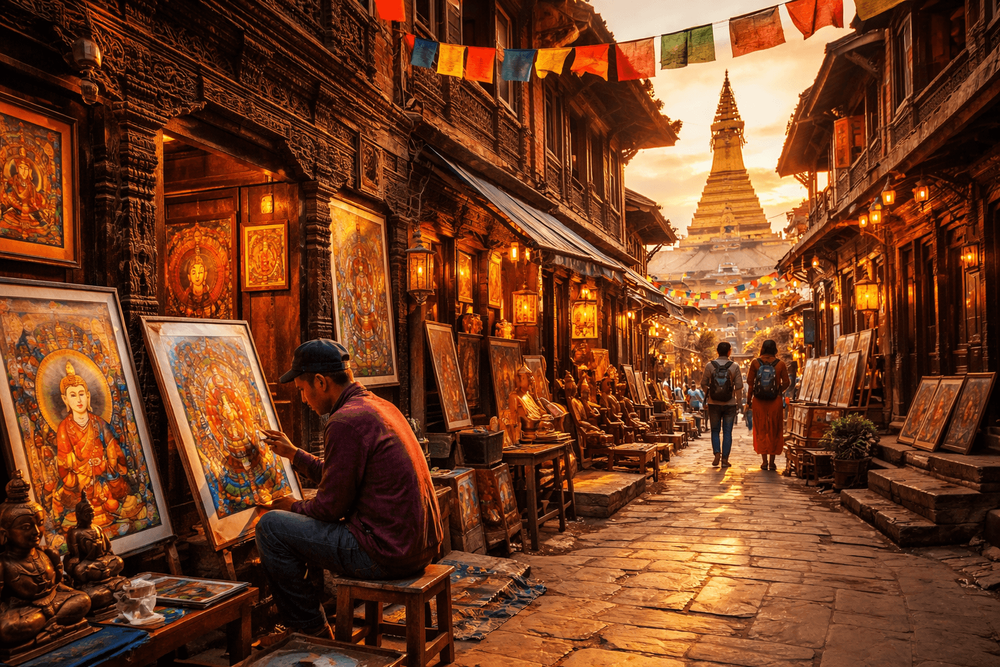
At dawn, the Boudha stupa glows the color of butter lamps as monks turn prayer wheels and thangka apprentices unroll canvases in small ateliers along the kora. Bells chime from nearby monasteries; a woman shakes powdered turquoise onto a mandala. This is the daily score of artistic neighborhoods in Nepal—places where craft is not a sideline to life but its heartbeat, where the past is repainted, carved, cast, thrown, and woven into the present.
Artistic Neighborhoods in Nepal: Where Creativity Lives

Lonely Planet Nepal: Detailed Itineraries | Travel Like a Local | Insider Tips | Covers Kathmandu, Pokhara, Terai, Mahabharat Range, and more (Travel Guide): Mayhew, Bradley, Bindloss, Joe, Brown, Lindsay, Butler, Stuart, Lama, Tsering
Lonely Planet's Nepal is <strong>our most comprehensive guide that extensively covers all the country has to offer, with recommendations for both popular and lesser-known experiences</strong>. Ex
Check Price on AmazonKathmandu: Thamel, Ason, and the Old City Courtyards
Thamel’s alleys thrum with the clack of woodblocks stamping patterns onto paper, the scent of incense from pocket-sized studios, and the metallic ring of chisels finishing repoussé earrings and ritual bowls. Between backpacker cafes and vinyl shops, small galleries exhibit contemporary canvases and photo essays while instrument makers tune sarangis and madals along narrow lanes.

Peak Design Capture Camera Clip V3, Black with Plate, Holds DSLR, Compact and Point and Shoot Bodies, Secure, Stable and Accessible, Attaches to Straps and Belts, Quick Release, 200 lb Capacity : Electronics
View on AmazonA few minutes’ walk to Ason and Indra Chowk, traders pile skeins of dyed yarn, conch-shell bangles, and glass-bead malas in pyramids of color. Duck into an Itumbaha courtyard and the urban riot softens: a woodcarver sands the filigreed lattice of a window frame, a paubha painter bends low over a canvas edged in gold, and grandmothers string bells for the temple next door. The pace is ancient, even as murals from the Kolor Kathmandu project peer from brick walls, introducing bold contemporary notes to the old city’s score.
Patan (Lalitpur): Bronze Fires and Brushstrokes
South of the Bagmati, Patan’s lanes around Durbar Square are a living academy of Newar artistry. Workshops behind the Golden Temple glow with forge-light where Shakya metalworkers hammer copper and gild bronze statues by hand, continuing a Malla-era lineage that furnished Buddhist art across the Himalaya. On quiet terraces, paubha painters grind mineral pigments—malachite, cinnabar—to apply with camel-hair brushes onto cotton or silk. The Patan Museum, housed in a restored royal palace, contextualizes this craft continuum, while contemporary spaces in Pulchowk and Jhamsikhel—Park Gallery, Bikalpa Art Center, and Yala Maya Kendra—host exhibitions, talks, and residencies that connect the heritage city to global conversations.
Bhaktapur and Thimi: Clay, Masks, and Medieval Grace
In Bhaktapur, the crunch of straw underfoot leads to Potter’s Square, where wheel-thrown bowls dry like river stones in the sun. Families shape seed jars and yogurt pots (juju dhau vessels) before blackening them in straw-fired kilns—a practice unchanged for centuries. Around Taumadhi and Dattatreya squares, mask carvers tint fierce Bhairav visages in cinnabar and lampblack. Nearby Thimi specializes in sturdy household ceramics and terracotta lamps; some studios offer hands-on instruction between batches, palms dusted red with clay.
Boudha: Thangkas, Monastic Arts, and Morning Light
Circling the great stupa at first light reveals an enclave of visual and ritual arts. Thangka schools display line drawings of bodhisattvas pinned to walls; masters teach students to steady their breath as they paint an eye or lotus petal. Shops sell meticulously detailed works, some brushed with 24k gold—meant for devotion as much as display. Around the corner, the Taragaon Museum hosts thoughtful exhibitions on Himalayan architecture, photography, and design, situating the neighborhood’s creativity in a broader cultural frame.
Jawalakhel, Kupondole, and Jhamsikhel: Fair-Trade Founders and Urban Studios
In Lalitpur’s southern neighborhoods, the Jawalakhel Tibetan Refugee Camp offers a glimpse of hand-knotted carpet making, its rhythmic looms producing geometric and floral designs once woven for nomad tents, now commissioned by designers worldwide. Kupondole’s fair-trade pioneers—Mahaguthi and Sana Hastakala—present ethically sourced crafts from across Nepal, while Jhamsikhel’s studios, cafes, and pop-ups showcase emerging painters, photographers, and ceramicists.
Lakeside Pokhara: Bohemian By the Water
Against the mirror of Phewa Lake, Pokhara’s Lakeside area nurtures a looser, bohemian scene. Artists here work between mountain treks and misty mornings on the shore, selling watercolor Himalayas, hand-bound journals, and contemporary mandalas from studios hidden above cafes. Street murals gather along side lanes; on weekends, live music spills from verandas as painters exhibit small works by candle- and fairy-light.
Emerging Regional Hubs: Tradition Revived and Reimagined
- Janakpur: The homeland of Mithila art, where bold, story-rich paintings cover paper, walls, and even trains of wedding sarees. The Janakpur Women’s Development Center trains and employs local artists whose brushwork narrates epics and everyday life in saturated color and pattern.
- Tansen (Palpa): Known for Dhaka weaving—the geometric cloth of the national topi—produced on home looms whose rhythmic click-clack is a town soundtrack.
- Bungamati and Khokana: Newar woodcarving and oil-pressing villages south of Patan, where intricately latticed windows and temple struts speak to artisanship under restoration since the 2015 earthquake.
- Kirtipur and Panauti: Hill towns with strong ritual performance traditions, lacemaking, and quiet ateliers working in paubha, masks, and temple ornaments.
- Lo Manthang (Upper Mustang): For intrepid travelers, monastic restorations and traditional wall painting workshops keep the medieval city’s sacred interiors vivid with mineral color and gold.
For those curious beyond the main hubs, consider adding remote creative valleys to an itinerary; Nepal’s craft geography broadens with each pass and river bend. See Nepal’s quieter corners in Nepal Off the Beaten Path: Remote Valleys, Hidden Treks & Authentic Encounters.
What They Make: From Paubha to Pottery and Performance
Traditional Crafts, Deep Lineages
- Paubha/Thangka: Newar paubha painting predates and influenced Tibetan thangka traditions. Works are defined by precise iconometry, mineral pigments, and often gold detailing. Many are consecrated for ritual use; others are created for collectors under a master’s supervision.
- Woodcarving: The Kathmandu Valley’s signature is its lattice windows (tikijhya), temple struts carved with deities, and toranas alive with mythical beasts. Post-earthquake conservation has spurred both restoration and new commissions.
- Metalwork: Repoussé and lost-wax casting in Patan yield copper and gilt-bronze statues with wax-smooth contours and finely chased details. Bell and vajra makers tune sound as meticulously as form.
- Pottery: Bhaktapur and Thimi potters throw functional forms and festival wares, burnishing pieces to an earthy sheen.
- Weaving and Textile Arts: From Palpa’s Dhaka to Tibetan carpets in Jawalakhel and wool shawls from highland communities, weaving interlaces economy and identity.
- Paper and Print: Lokta paper—made from Himalayan bark—dries in sunlit frames, later block-printed with auspicious symbols.
Contemporary Visual Arts and Street Culture
Kathmandu’s modern art matured alongside the restoration of its heritage architecture. Siddhartha Art Gallery in Baber Mahal Revisited champions Nepali contemporary art with international reach; Nepal Art Council mounts ambitious group shows and retrospectives. In Patan, Park Gallery and Bikalpa Art Center offer residencies, experimental programs, and cross-genre collaborations. Around the valley, remnants of the citywide Kolor Kathmandu mural project—plus newer commissions—turn brick lanes into open-air galleries.
Performance Arts: Drums, Masks, and Stage Lights
From the sweep of Lakhey masks and chariot festivals to intimate bhajan singing at Patan’s Krishna Mandir, performance is interwoven with ritual calendars. Visitors can catch classical and folk dance at Rastriya Naach Ghar (National Dance House) or contemporary Nepali drama at Mandala Theatre. In Boudha and Swayambhu, chant and horn call frame monastic cham dances on auspicious dates. Plan trips around cultural calendars with Festival Trail Nepal: How to Experience Nepal’s Rich Cultural Celebrations.
Visitor Experiences: Galleries, Workshops, Markets
Galleries and Artist-Run Spaces Worth a Detour
- Siddhartha Art Gallery (Baber Mahal Revisited): Curated exhibitions by established and emerging artists, artist talks, and catalogues that double as cultural records.
- Nepal Art Council (Babar Mahal): Large-scale thematic shows mapping the country’s visual narrative.
- Taragaon Museum (Boudha): Architecture, photography, and design exhibitions in a striking mid-century complex by Austrian architect Carl Pruscha.
- Park Gallery, Bikalpa Art Center, Yala Maya Kendra (Patan): Rotating exhibitions, screenings, and residencies that ground visitors in the city’s contemporary discourse.
Hours vary by venue; many close one day a week and on festival days. Late afternoons and early evenings see the liveliest openings.
Hands-On: Learn by Doing
- Pottery: Spend a morning at a studio around Bhaktapur’s Potter’s Square or in Thimi, learning to center clay and form bowls. Most classes include firing and packing for travel.
- Paubha/Thangka: Short introductions in Boudha cover brush handling, grid drawing, and pigment preparation; longer workshops may let students complete a small deity portrait.
- Wood and Metal: Patan workshops occasionally offer carving or repoussé sessions. Even without classes, visitors can observe chiseling, casting, and gilding—ask politely and offer a workshop donation.
- Carpet Weaving: In Jawalakhel, learn knotting techniques and the coding of patterns from master weavers.
Always book ahead, dress modestly, and ask before photographing people or in sacred spaces.
Markets and Buying Tips
Ason and Indra Chowk are lifelines for beads, yarns, and ritual items; Boudha’s kora is lined with thangkas, singing bowls, and incense; Patan’s alleys reveal wood, metal, and paubha studios tucked behind carved doorways. For an insider’s primer to bargaining styles, vendor etiquette, and what to buy where, see Shop Like a Local: Nepal’s Best Markets for Food, Handicrafts & Culture.

ITOYA 18x24 Art Profolio Multi-Ring Refillable Binder, Holds 40 Sheets, 80 Views, Black : Photo Presentation Portfolios
View on Amazon- Authenticity markers: For thangkas, look for mineral pigments and gold leaf, balanced proportions per iconometric grids, and a studio signature. For metal statuary, makers should state alloy and finishing; avoid artificially aged patinas passed as antiques. Woodcarvings should show crisp tool marks and natural grain—mass-produced resin copies are common.
- Documentation: Request a VAT bill, artist/workshop details, and, for high-value pieces, a provenance letter. Nepal prohibits export of true antiques (typically over 100 years old). When in doubt, buy new.
- Shipping: Reputable galleries arrange packing and insured courier shipping. Roll thangkas around a soft core and wrap in acid-free paper. Avoid postal services for high-value items.
- Pricing: Complex paubhas or large bronzes can take months of labor; expect pricing to reflect skill and time. Great small buys include lokta journals, hand-forged utensils, and contemporary prints.
Where to Stay to Soak It In
- The Swotha Heritage House places travelers in a lovingly restored courtyard steps from Patan Durbar Square; its timber balconies and breakfast on a sunlit terrace feel like an atelier of their own.
- In Bhaktapur, the Peacock Guest House occupies a brick-and-timber Newar mansion where carved windows frame the daily theater of Taumadhi Square.
- By Phewa Lake, Temple Tree Resort & Spa offers quiet gardens and verandas—an easy base for studio-hopping by day and lakeside openings at dusk.
Cultural Context and Responsible Support
The Kathmandu Valley’s artisanship traces back to the Licchavi and Malla periods, when temple building and royal patronage demanded excellence in wood, stone, metal, and paint. Newar guilds—organized by caste and craft—codified skills that radiated into Tibet and across the trade routes of the Silk Road. Today, those hand skills are both heritage and livelihood.
- Ethical purchasing: Favor artist studios, transparent galleries, and cooperatives. Janakpur Women’s Development Center, Mahaguthi, and Sana Hastakala ensure fair pay and training, with profits reinvested in communities.
- Conservation concerns: Resist the lure of “antique” statuary and temple fragments—these may be illicitly removed. Choose contemporary works inspired by heritage instead.
- Credit and consent: If photographing artisans, ask permission and credit artists when posting. Offer to purchase a small item or tip for extended demonstrations.
- Community investment: Workshops may welcome donations toward apprenticeships or tool funds; even small contributions help sustain lineages of skill.
For broader cultural etiquette, safety, and practical advice, bookmark Top Travel Tips for Nepal: Practical, Safe, and Responsible Advice for First-Time Visitors.
Practicalities: Timing, Access, and Etiquette
- Best time to visit: October–November and March–April bring clear skies and a busy calendar of exhibitions and festivals. Photo Kathmandu and the Kathmandu Triennale rotate across years; October’s Indra Jatra, Patan’s Rato Machhindranath chariot festival, Tihar’s flower-and-light displays, and Tibetan Losar in Boudha infuse streets with performance and ritual art.
- Getting around: Taxis and ride-hailing apps cover short hops between Thamel, Patan, Boudha, and Bhaktapur. Traffic is heaviest mid-afternoon; early mornings reward with quiet studios and golden light for photography. Day trips reach Bhaktapur/Thimi, Bungamati/Khokana, or Kirtipur; Janakpur is a short flight from Kathmandu.
- Tickets and hours: UNESCO squares (Patan, Bhaktapur) require entry tickets that help fund conservation—keep yours handy for re-entry. Museums and galleries keep varied hours and may close for festivals; check ahead.
- Etiquette: Remove shoes in monasteries and some workshops; dress modestly; avoid flash in sacred spaces; never touch ritual objects without permission. In markets, bargaining is expected but should remain friendly and respectful.
Walking these artistic neighborhoods in Nepal is to glimpse hands that have shaped a civilization’s face—callused, steady, and inventive. Whether hunched over a mandala or hauling a kiln’s straw, makers here practice an art of patience that outlasts trend and season. Visitors leave with more than an object; they carry the afterglow of craft itself, a quiet, enduring light.
Recommended Travel Gear
Lonely Planet Nepal: Detailed Itineraries | Travel Like a Local | Insider Tips | Covers Kathmandu, Pokhara, Terai, Mahabharat Range, and more (Travel Guide): Mayhew, Bradley, Bindloss, Joe, Brown, Lindsay, Butler, Stuart, Lama, Tsering
Lonely Planet's Nepal is <strong>our most comprehensive guide that extensively covers all the country has to offer, with recommendations for both popular and lesser-known experiences</strong>. Ex
Peak Design Capture Camera Clip V3, Black with Plate, Holds DSLR, Compact and Point and Shoot Bodies, Secure, Stable and Accessible, Attaches to Straps and Belts, Quick Release, 200 lb Capacity : Electronics
Amazon.com : Peak Design Capture Camera Clip V3, Black with Plate, <strong>Holds DSLR, Compact and Point and Shoot Bodies, Secure, Stable and Accessible, Attaches to Straps and Belts, Quick Release, 2
ITOYA 18x24 Art Profolio Multi-Ring Refillable Binder, Holds 40 Sheets, 80 Views, Black : Photo Presentation Portfolios
This Itoya 18x24 Multi-Ring Refillable Portfolio Presentation Binder <strong>features a sleek, contemporary exterior design with durable, matte black precision steel binder rings</strong>. The polypro