
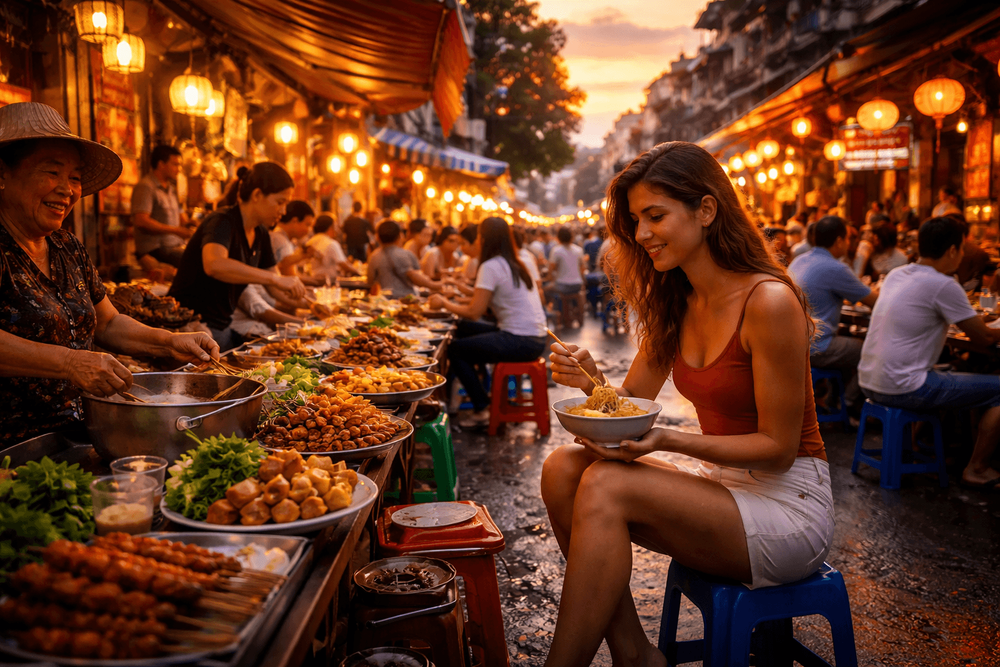
Street Food Adventures in Vietnam: What to Eat, Where to Go, and How to Eat Like a Local
Bowl by bowl and bite by bite, this guide maps Vietnam’s essential street eats—what to order, where to find them, and how to dine like a savvy local.
Mood
Culinary Street Odyssey
At first light, steam rises in ribboned veils from a tin cauldron on a Hanoi pavement, fogging the glass and perfuming the air with star anise. Scooters idle like a soft drumroll, plastic stools scrape across tile, and the vendor’s ladle dips with practiced grace. This is the heartbeat of street food adventures in Vietnam: a country where breakfast is taken curbside, flavors are layered with history, and every block seems to hum with the promise of something sizzling, slurping, and deeply satisfying.
What to Eat: Vietnam’s Street Icons, Bowl by Bowl
Phở
The national shorthand for comfort, phở is a study in restraint and balance. In Hanoi, the broth runs clear and subtle—beef bones simmered for hours with charred ginger and onions, laced with star anise and cinnamon—meant to be sipped in quiet appreciation. In the south, it grows rounder and a touch sweeter, garnished with handfuls of herbs and bean sprouts. A squeeze of lime brightens; a whisper of chili enlivens. Beyond taste, phở symbolizes a unifying thread in Vietnam’s morning ritual: a hot bowl to anchor the day.
Bánh mì
Crackling baguette, airy crumb, and a swagger of contrasts—bánh mì is France refracted through Vietnamese ingenuity. Paté and cold cuts or caramelized pork? Pickled carrots and daikon for snap, cucumbers for coolness, and a dab of mayonnaise or Maggi for umami. Regional riffs abound: sardines in tomato sauce by the coast, grilled pork with lemongrass in the south, or egg-and-butter simplicity on sleepy mornings.
Bún chả
Hanoi’s smoky signature. Fat-laced pork patties and ribbons of belly are grilled over charcoal, their edges blistering and aromatic. They land in a bowl of warm, lightly sweetened fish sauce with pickled green papaya; a separate nest of vermicelli and a plate of herbs complete the architecture. Diners compose each bite at the table—pork, noodles, herbs, dip—building a chorus of char, acid, and brightness.
Bún bò Huế
Not phở’s cousin so much as its fiery foil, bún bò Huế announces itself with lemongrass perfume and a chili-backed glow. The broth is muscular—beef shank, pork hock, and aromatics—enriched by annatto and fermented shrimp paste for a haunting depth. Thick rice noodles give chew; a squeeze of calamansi or lime pulls the flavors taut. It is central Vietnam’s proud anthem in a bowl.
Cao lầu
Hoi An’s enigmatic specialty is defined by texture: firm, toothsome noodles traditionally made with lye water and ash-filtered well water. Toppings are spare but resonant—soy-braised pork, crisp rice crackers, and sharp herbs—so the noodles’ bounce steals the show. It tastes like Hoi An’s history of trade routes and cross-cultural exchange, captured in a quiet, satisfying tangle.
Bánh xèo
The name means “sizzling cake,” and the show begins on the pan. A turmeric-tinted batter fans out thin and lacy; shrimp, pork, and bean sprouts tumble in before the fold. Wrapped in lettuce with herbs and dunked into a tangy-sweet nước chấm, each bite fractures into crisp, tender, cool, and warm—a textural pas de deux.
Seafood and Ốc (Snails)
Coastal nights sparkle with charcoal braziers and platters of shellfish: scallops crowned with scallion oil and peanuts, clams steamed with lemongrass, sea snails tossed in coconutty curry or smoldering chili. The ritual is social and messy, best with cold beer and good company. Flavors are bright and direct—lime-salt dips, mỡ hành (scallion oil), and fresh herbs sharpened by sea breeze.
Chè (Vietnamese Sweets)
From lotus seed and longan sweet soups to the tri-colored joy of chè ba màu, these desserts refresh rather than weigh down. Shaved ice clinks, coconut cream softens, and pandan, mung bean, or grass jelly contribute perfume and bounce. In Hue, chè stalls present a kaleidoscope of options in glass jars; in Saigon, plastic cups brim with color and childhood nostalgia.
Where to Find Them: Neighborhoods, Markets, and Night Hubs
Hanoi
- Old Quarter: Dawn belongs to phở pots on narrow lanes, while midday is for bún chả smoke trailing beneath tangled electrical lines. Around Hang Buom and Ta Hien, the evening scene swells with snacks and bia hơi. For historical context while plotting an eating crawl, pair your wander with Historic Hanoi: Must‑See Sites, Stories & Smart Visitor Tips.
- Dong Xuan Market and nearby alleys: A maze of vendors slinging bánh cuốn (steamed rice rolls), sticky rice, and seasonal fruits. Early mornings are prime.
- Tran Quoc Pagoda lakeside lanes and West Lake edges: Weekend afternoons bring dessert carts and grilled skewers with sunset views.
Where to stay: The Capella Hanoi sits a short stroll from the Opera House; after a night market graze, its theatrical Art Deco interiors feel like slipping into champagne.
Ho Chi Minh City (Saigon)
- Ben Thanh Market and surrounding streets (District 1): Touristy but efficient for first-timers—bánh xèo counters, bún thịt nướng, and chè all within steps.
- Vinh Khanh Street (District 4): A militantly delicious avenue of seafood and ốc; expect a carnival of flames and shell cracking.
- Nguyen Thuong Hien and Co Giang Street: Classic Saigon street eats—bánh mì gà quay, bột chiên (fried rice flour cakes), and late-night congee.
Where to stay: The Hotel des Arts Saigon pairs rooftop cityscapes with an address that puts District 1’s street food radius squarely at your feet.
Hoi An
- Hoi An Central Market: A mid-morning wander yields cao lầu and mì Quảng counters, their noodles springy and broths fragrant with turmeric and shrimp.
- Nguyen Hoang Night Market: Lantern-lit stalls dish out bánh xèo, grilled skewers, and cups of chè bắp (corn pudding) as the river glows amber.
- An Bang Beach: Late afternoons summon seafood shacks plating whole grilled fish and scallops with mỡ hành as kites skitter overhead.
Where to stay: The Anantara Hoi An Resort fronts the Thu Bon River; its leafy courtyards make a refined base between market snacks and beach grills.
Hue
- Dong Ba Market: The epicenter for bún bò Huế at breakfast, plus Hue’s petite royal bites—bánh bèo, bánh nậm—delicate, steamed, and set with shrimp floss.
- Truong Tien Bridge and Vo Thi Sau walking street: After dark, vendor carts bloom with sizzling bánh khoái (Hue’s crisp, saucy cousin to bánh xèo) and rainbow rows of chè.
Coastal Towns and Islands
- Da Nang: My Khe’s sunset brings seafood BBQs; An Thuong night market caters to grazers with skewers, pancakes, and sweet soups.
- Nha Trang: Xom Moi Market in the morning for fish fresh off the boats; in the evening, sidewalk grills perfume Tran Phu’s off-streets with scallop and squid.
- Quy Nhon and Phu Quoc: Low-key, seafood-first scenes—look for handwritten boards listing the day’s catch, priced by the kilo.
For a deeper dive into open-air dining culture, scan our guide to Bite-Sized Vietnam: Your Guide to Street Food Markets and map it against your route.
Safety, Hygiene, and Ordering: How to Navigate the Streets
- Read the crowd: Busy stalls turn over ingredients quickly—a simple, reliable proxy for freshness.
- Heat is your friend: Favor dishes cooked to order, served piping hot. Boiling broths, sizzling pans, and fresh grills are safer bets than long-sitting items.
- Watch the setup: Look for vendors using tongs or gloves, covered ingredients, and a tidy cutting board. Peek at the dishwashing station; three basins (wash, rinse, sanitize) is a good sign.
- Ice and water: Tap water isn’t potable. Ask for bottled water or “đá sạch” (clean ice) at reputable places; skip ice if unsure.
- Allergies: Peanut and shellfish cross-contact is common; see phrases below and alert vendors before ordering. Fish sauce (nước mắm) is ubiquitous—even in “vegetable” dishes—so specify if you avoid it.
- Payment: Cash rules. Keep small notes (10,000–50,000 VND). Pay at the end; no need to tip, but rounding up is appreciated.
- Portions and pricing: Street portions invite grazing—expect 20,000–40,000 VND for bánh mì, 35,000–70,000 VND for noodle bowls, 10,000–25,000 VND for chè. Seafood is often priced by weight; confirm per-kilo rates first.
How to order (simple phrases)
- “Cho em một bát phở/bún bò Huế/bún chả.” (Please give me one bowl of phở/bún bò Huế/bún chả.)
- “Ít ớt/không ớt.” (Less chili/no chili.)
- “Không hành/không thịt/không nước mắm.” (No scallions/no meat/no fish sauce.)
- “Bao nhiêu tiền?” (How much is it?)
- “Ăn tại chỗ hay mang về?” (Eat here or take away?)
- “Cảm ơn.” (Thank you.)

Lonely Planet Vietnamese Phrasebook & Dictionary: Planet, Lonely
The Perfect Choice:Lonely Planet's Vietnamese Phrasebook and Dictionary, <strong>a pocket-sized comprehensive language guide</strong>, provides on-the-go language assistance; great for language s
Check Price on AmazonFor broader travel logistics, seasonal timing, and safety know-how, bookmark Vietnam Adventure Essentials: Where to Go, When to Go, and How to Do It Safely.
Cultural Context and Etiquette at the Curbside Table
- Take a seat first: In many stalls, diners sit and the vendor comes to take the order—or recognizes regulars with a nod. Hovering over the pot is unnecessary.
- Share and pass: Eating is communal. Place herbs and condiments within reach and pass them along. Slurping is fine; it reads as appreciation.
- Queue with your eyes: Lines can be fluid. If there’s no formal queue, note who arrived before you and gesture for them to go first when the vendor looks up.
- Keep the sidewalk flowing: Tuck stools and feet under the table; vendors value unobstructed space.
- Tipping and trash: No formal tipping. Hand back bowls neatly and pop napkins into the bin or the vendor’s waste basket—never the gutter.
- Photography grace: Ask before photographing a person; a smile and a gesture to your camera usually suffice. Avoid blocking the stall in pursuit of the perfect angle.
Planning Your Street Food Adventures in Vietnam
Timing your appetite
- Morning (6–10 a.m.): Phở, bún bò Huế, sticky rice, and strong coffee. Vendors set up early; broths are freshest now.
- Midday (11 a.m.–2 p.m.): Bún chả, cơm tấm, and rice plates. Heat rises; seek shaded alleys or fan-cooled shophouses.
- Evening to late night (5–11 p.m.): Bánh xèo, seafood grills, ốc, and chè. Night markets hit their stride after sunset.
Budgeting a day of grazing
- Breakfast bowl + coffee: 60,000–90,000 VND
- Midday noodles or rice plate: 40,000–70,000 VND
- Snack (spring rolls, sugarcane juice): 20,000–40,000 VND
- Dinner crawl (2–3 small plates + beer): 120,000–250,000 VND A flavorful, full day of street eating can easily land between 250,000 and 450,000 VND (US$10–18) per person, more if seafood is the headliner.
Dietary alternatives and allergy advice
- Vegetarian/Vegan: Look for “chay” signs or ask “Có món chay không?” (Do you have vegetarian dishes?). Bún chay, cơm chay, tofu stir-fries, and mushroom bánh xèo are common. Buddhist temple kitchens often serve excellent vegan lunches.
- Gluten-aware: Most rice noodles are naturally gluten-free, but soy sauces can contain wheat. Cao lầu noodles, while rice-based, may be prepared in shared environments—ask if sensitive.
- Fish sauce: To avoid it, request “không nước mắm.” Many vendors can offer salt and lime, soy, or vegetarian dipping sauces on request.
- Peanut and shellfish: Say “Dị ứng đậu phộng/hải sản” (I’m allergic to peanuts/seafood). Watch for garnishes like crushed peanuts and mỡ hành with hidden seafood condiments.
Sustainability notes
- Carry a reusable chopstick set and metal straw; bring a tiffin for take-away. Many vendors are happy to fill it.
- Refill water at hotels and cafes to cut plastic. For broader eco-choices on the road, see Sustainable Travel Options in Vietnam: Eco Transport, Community Stays & Responsible Tours.
Photography and sensory cues
- Chase steam and sizzle: Position yourself where backlight catches broth vapors or the pan’s spray of oil. Skip flash; ask to stand briefly behind the counter for a shot of the action.
- Listen for the cook’s cadence: The percussive chop of cleavers, the hiss of batter hitting a hot pan—sound guides the senses as much as scent.
- Color is flavor: Herb baskets, pickled vegetables, and sauce caddies are as photogenic as the main dish; shoot them to tell the full story.
Pro tips for spotting the good stuff
- Short menus signal mastery; a single specialty often means generational know-how.
- Local rhythms matter: Follow office workers at lunch and families after dusk; they know when a stall is at its best.
- Handwritten prices = fair play. If none are posted, confirm politely before ordering.
For market-to-street navigation beyond the big cities, cross-reference routes with Bite-Sized Vietnam: Your Guide to Street Food Markets and build your tasting map town by town.
The Lasting Taste
Long after the ticket home is stamped, memories linger: the lacquered crackle of a just-torched bánh mì crust; the soft clatter of ice in a cup of chè under Hue’s indigo night; the way lemongrass and chili braid in a bowl of bún bò Huế until they feel inseparable. Street food adventures in Vietnam are ultimately about proximity—to heat, to craft, to the people who turn a sidewalk into a dining room. Pull up a little plastic stool, and the country tells its story one perfect, ephemeral bite at a time.

ECOlunchbox Tri Bento 3-Tier Stainless Steel Lunch Box | 4.5 Cups (36 oz) Capacity | 5.25 x 5.25 x 4 inches (13.5 x 13.5 x 10 cm) | Perfect for Meal Prep, Snacks & Portion Control | Durable, BPA Free: Lunch Boxes
View on Amazon
DEVICO Portable Utensils, Travel Camping Cutlery Set, ...
View on AmazonRecommended Travel Gear
Lonely Planet Vietnamese Phrasebook & Dictionary: Planet, Lonely
The Perfect Choice:Lonely Planet's Vietnamese Phrasebook and Dictionary, <strong>a pocket-sized comprehensive language guide</strong>, provides on-the-go language assistance; great for language s
ECOlunchbox Tri Bento 3-Tier Stainless Steel Lunch Box | 4.5 Cups (36 oz) Capacity | 5.25 x 5.25 x 4 inches (13.5 x 13.5 x 10 cm) | Perfect for Meal Prep, Snacks & Portion Control | Durable, BPA Free: Lunch Boxes
Stacking and packing a healthy ... that's <strong>made up of three separate layers which neatly clip together. The shape of our Tri Bento lunchbox is classic of the round stainless steel "ti
DEVICO Portable Utensils, Travel Camping Cutlery Set, ...
Amazon.com : DEVICO Portable Utensils, Travel Camping Cutlery Set, <strong>8-Piece including Knife Fork Spoon Chopsticks Cleaning Brush Straws Portable Case, Stainless Steel Flatware set (Black)</stro