
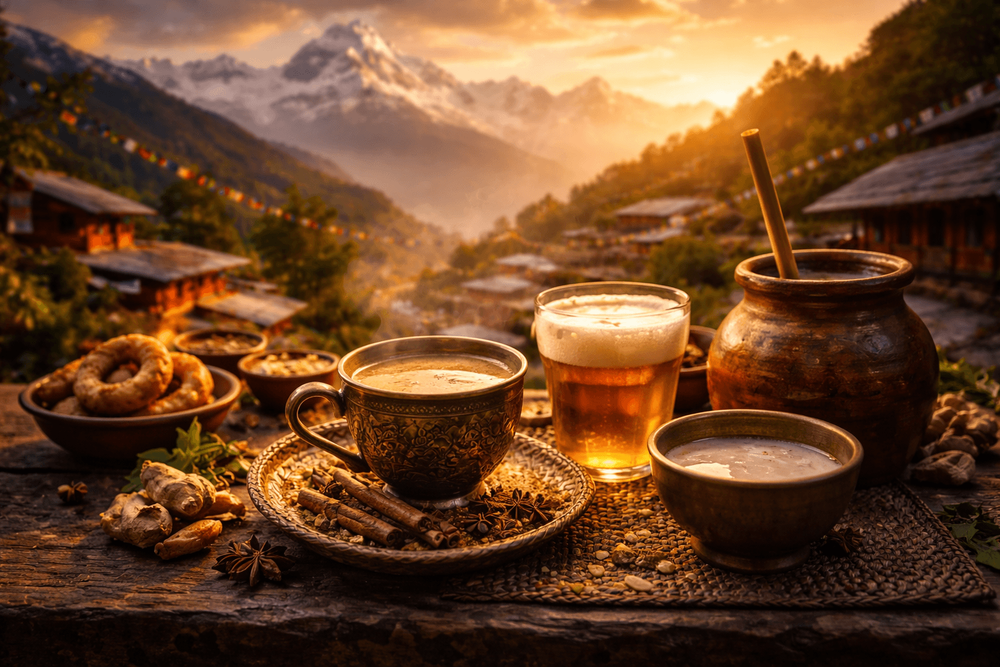
Must-Try Beverages in Nepal — Chiya, Chhaang and Regional Sips
From chiya and butter tea to raksi, chhaang and tongba—sip Nepal’s story in a cup. Where to find them, how to order, and the rituals behind every pour.
Mood
Culinary Deep-Dive
At first light in Kathmandu’s Asan Bazaar, brass kettles hiss and sigh, releasing ribbons of cardamom steam into the chill. A teashop auntie clinks glasses as porters shoulder loads and rickshaws creak into motion. Here, the day begins with ritual: a small, hot cup clasped between palms. It’s the perfect place to start exploring the must-try beverages in Nepal—drinks that carry the warmth of the hearth, the bite of mountain air, and centuries of hospitality in every sip.
Must-Try Beverages in Nepal: Comforts in a Cup
Chiya (Nepali Milk Tea)
The country’s morning heartbeat is chiya: robust black tea brewed hard, softened with full-fat milk (often buffalo), and sweetened until the edges blur. On the plains of the Terai it tends to run sweeter and lighter; in the Kathmandu Valley, it arrives richer and more caramel-toned; in the hills, ginger and cardamom band together for a fragrant, warming cup. You’ll find it everywhere—from tiny roadside bhattis and market stalls to trekking tea houses where thin metal cups chase the cold from your fingers.
How to order: “Ek kap dudh chiya, kripaya” (one cup milk tea, please). Prefer less sugar? Ask for “chini kam.” Want it black? “Kalo chiya.”
Where to try it: Old-city alleys of Kathmandu and Patan; hill towns like Bandipur; bus-stand stalls from Pokhara to Dharan. For a refined take, some cafés offer single-origin Ilam tea pulled into masala blends.
Food pairing: Chiya thrives alongside crispy samosas, flaky khaja pastries, or the ring-shaped sweetness of sel roti. If you’re planning a snack-led wander, see Taste Nepal’s street-side essentials for ideas on what to nibble while you sip: Taste Nepal: Must-Try Street Foods, Where to Find Them and How to Eat Like a Local.
Where to linger: Base yourself amid carved wood and brick at the storied Dwarika’s Hotel. Its courtyards feel made for slow mornings—chiya in hand as doves wheel over terracotta eaves.
Po Cha (Tibetan Butter Tea)
Higher into the Himalaya, warmth becomes sustenance. Po cha—Tibetan butter tea—is black tea simmered long, enriched with yak (or cow) butter and a pinch of salt, then churned aerated. It’s savory more than sweet, silky on the lips, and engineered for altitude life: calories, hydrating salts, and heat. In Sherpa and Tibetan communities of Solukhumbu, Mustang, and around Boudhanath in Kathmandu, butter tea is hospitality itself, pressed into your hands with a smile you can’t refuse.
How to approach it: Think of a light broth with a buttery finish rather than “tea” as you know it. Pair it with tsampa (roasted barley flour), momos, or hard yak cheese for a properly alpine snack.
Where to try it: Monastery guesthouses and mountain lodges on Everest and Annapurna routes; Tibetan settlement cafés near Boudha (Kathmandu) and Tashi Ling in Pokhara.
Black Teas of Ilam
In the misty east, carpeted hills give way to the country’s most famous tea gardens. Ilam’s orthodox black teas tend toward malty and floral, while neighboring estates experiment with green and oolong. Order a glass unadorned to appreciate their character, or request a gentle masala infusion. Many homestays and small teahouses here pour with pride, offering tastings overlooking tea-terraced slopes.
The Traditional Spirits: Raksi, Chhaang and Tongba
Nepal’s alcoholic heritage is a tapestry of grains and microclimates, from millet fields in the middle hills to rice paddies in the lowlands. These drinks are not simply nightcaps; they mark festivals, seal friendships, and carry stories from hearth to harvest.
Raksi (and Newari Aila)
Raksi is a clear, home-distilled spirit made from millet, rice, or barley—dry, clean, and variable in strength (often 20–40% ABV, but homemade versions may be stronger). In the Newar community, aila—an especially aromatic, carefully distilled variant—takes center stage at ceremonial feasts. Elders pour from elegant metal vessels, a graceful arc into tiny bowls, as offerings are made to deities and ancestors.
What to expect: A raksi’s nose can be floral or lightly smoky, depending on the grain and still. Sipped neat, it warms quickly. In rural homes it’s served with respect; in urban bars you may find it softened with citrus or local herbs.
When it appears: Weddings, harvest celebrations, and Newari feasts (think samay baji platters with beaten rice, spiced buffalo choila, and crispy black soybeans).
Traveler tip: Taste where quality and hygiene are taken seriously—cultural restaurants, reputable homestays, or licensed producers—especially if you’re unfamiliar with homemade spirits.
Chhaang (Millet or Rice Beer)
Cloudy and softly sour, chhaang is a lightly alcoholic brew (typically 2–6% ABV) that bridges beer and grain-based ferment. It arrives in steel tumblers or sturdy glasses, sometimes warmed on cold nights. Among Tamang, Sherpa, and Gurung communities, chhaang is communal—a toast to the day’s work, a shared bowl at Losar (New Year), and a steady hum beneath festivals.
Flavor notes: Yogurty tang, cereal sweetness, a whisper of wild yeast. It pairs beautifully with warming soups, dumplings, or grilled meats.
Tongba (Hot Millet Brew)
Tongba is eastern Nepal’s winter soul. A cylindrical wooden vessel is packed with fermented millet, then topped with boiling water and sipped through a bamboo straw fitted with a filter. As you draw, the hot water extracts alcohol and flavor from the grains—refill after refill, the drink evolves from mellow to gently sweet and earthy. ABV is modest but creeps up with patience.
Where to sip it: Limbu and Rai hearths in the hills east of Dharan and Ilam; hill-town taverns across the country in winter; mountain lodges on crisp nights.
Etiquette: The host often offers the first pour. Take a slow sip and acknowledge with a nod or “dherai mitho chha” (it’s very tasty) to honor their craft.
Beer lovers: Modern craft taps are bubbling across Kathmandu and Pokhara. For a full hop-forward circuit, bookmark Brews of the Himalaya: Exploring Nepal’s Local Breweries.
Seasonal and Lesser-Known Sips
Nepal’s microclimates deliver a rotating cast of refreshers and tonics—street-side and homemade, functional and delightful.
Ginger-Lime and “Hot Lemon”
Every trekking lodge stocks hot lemon (often with honey) and ginger-lime coolers. At altitude, these are comfort in a mug: steam curling across windowpanes as snowfields glow outside. Ginger settles the stomach, honey soothes the throat, and citrus cuts through the day’s dust.

Hydro Flask Water Bottle - Insulated Stainless Steel - Wide Mouth Flex Lid, Non Spill, Leakproof and Refillable in 20 Oz Agave
Hydro Flask Water Bottle - Insulated Stainless Steel - Wide Mouth Flex Lid, Non Spill, Leakproof and Refillable in 32 Oz <strong>Agave Green</strong> · Hydro Flask Water Bottle - Insulated Stainless S
Check Price on AmazonHow to order: “Hot lemon with honey” is universally understood; for extra bite, ask for “aduwa” (ginger).
Lassi, Yogurt Drinks and Juju Dhau
From the Terai northwards, lassi is the summer balm—thick yogurt whisked with sugar, cardamom, sometimes rosewater or seasonal mango. In Bhaktapur, the famed juju dhau (king of curds) finds its way into creamy drinks served in clay cups, cool against the palm even as the sun beats down on brick squares.
Perceived benefits: Cooling, probiotic, a gentle reset after spice-heavy meals.
Cane-Crushers and Fruit Nectars
In the lowlands, hand-cranked presses chatter out sugarcane juice tinted with lime and ginger—a grassy-sweet elixir that tastes of monsoon afternoons. Look also for bel sharbat (from wood apple), amla (gooseberry) juice, and fresh orange or pomegranate in winter markets.
Street smarts: Choose stalls that press to order and rinse glasses well; decline ice if you’re sensitive to water purity.
Herbal and High-Mountain Brews
Along high trails and in remote valleys, rhododendron petals steep into a blush-pink tea with a delicate, honeyed edge; sea buckthorn (hip-high shrubs in Mustang and Dolpo) yields a brilliantly tart, vitamin-packed juice; tulsi (holy basil) and lemongrass infusions waft from kitchen hearths on chilly evenings. Locals reach for these to fend off colds, soothe digestion, and welcome sleep.
Where to go slow: Evenings above Pokhara’s lakes shimmer with lantern light—an atmospheric moment to linger over herbal infusions at Tiger Mountain Pokhara Lodge, where verandas open to a sawtooth horizon.
Etiquette, Language and Pairings
Drinking in Nepal is first and foremost about welcome. The customs are gentle but meaningful.
Lonely Planet Nepali Phrasebook & Dictionary 6: O'Rourke, Mary-Jo, Man Shrestha, Bimal, Pradhan, Krishna
Lonely Planet NepaliPhrasebook & Dictionary is <strong>your passport to the most relevant Nepali phrases and vocabulary for all your travel needs</strong>. Know how to organise your mountaineering
Check Price on Amazon- Accepting and refusing: Receive a cup with the right hand while the left lightly touches your forearm—a small sign of respect. If you’re full, place your palm over the rim and say “pugyo, dhanyabad” (enough, thank you).
- Toasting: A simple “cheers” is widely understood; to go local, try “swasthya ko lagi!” (to health!).
- Sacred sips: In many homes, the first drops of tea or aila are flicked to the ground as an offering. During festivals, specific drinks hold ritual weight—an aspect explored on our Festival Trail Nepal.
- Modesty matters: Public intoxication is frowned upon in conservative settings; pace yourself and read the room.
Classic pairings to try:
- Chiya with sel roti, khaja sets, and train-station biscuits that soften perfectly in milky sweetness.
- Butter tea with tsampa, momos, and yak cheese—calories for cold air.
- Raksi with Newari samay baji and spicy choila; the spirit’s clean line cuts the richness.
- Chhaang and tongba with thukpa (noodle soup), sukuti (dried meat), or crispy pakoras after a day on the trail.
- Lassi or bel sharbat after market rambles and chili-laced chats.
If you prefer a curated introduction to flavor and context, sign up for a chef-led tasting on Gourmet Food Tours in Nepal: Taste, Learn, and Shop Your Way Through Kathmandu & Beyond.
Where to Drink, Safety and Practicalities
Authentic venues:
- Markets and alleys: Asan and Indra Chowk in Kathmandu; Patan’s Mangal Bazaar; Pokhara’s Old Bazaar. Watch for dented kettles, billowing steam, and stacks of glass cups—the sign of a good pour.
- Trekking tea houses: From Ghorepani to Namche, lodges fuel hikers with hot lemon, ginger tea, and, later, modest pours of chhaang or raksi.
- Homestays and community lodges: The best place to meet tongba, chhaang, and house-distilled spirits with stories attached. Your host will guide you through their making and meaning.
- Tibetan settlements and monasteries: Butter tea appears as ritual and comfort—accept at least a small sip if offered.
Safety notes and altitude wisdom:
- Homemade spirits vary in strength and purity. Sample where hygiene is clear; if something smells harshly chemical or off, decline with a smile and “pugyo, dhanyabad.”
- At altitude, alcohol dehydrates and can worsen sleep and acclimatization. Save raksi and tongba for after you’ve adjusted; choose hot lemon, soups, and abundant water early on.
- Fresh juices are best pressed to order. Skip ice and unsealed bottled water if your stomach is sensitive.
Price expectations (subject to region and venue):
- Chiya at a local stall: NPR 20–70; café masala blends: NPR 100–250.
- Hot lemon or ginger-lime at trekking lodges: NPR 150–350.
- Lassi or fruit nectars: NPR 120–300 (seasonal mango higher).
- Chhaang: NPR 100–250 per glass; tongba: NPR 200–400 per vessel.
- Raksi/aila: NPR 200–600 per serving in restaurants; less in homestays.
Smart logistics:
- Cash is king in small stalls; carry small notes.
- Stainless-steel or glass cups are standard at roadside shops. If you carry your own reusable cup or bottle, many teahouses will happily fill it.
- For first-timers, a quick scan of practical etiquette around tipping, water, and health is helpful; keep this guide close: Top Travel Tips for Nepal: Practical, Safe, and Responsible Advice for First-Time Visitors.
Where to stay for a tasting-led trip:
- In Patan’s quiet backstreets, Traditional Homes - Swotha occupies renovated townhouses where mornings start with cinnamon on the air and a perfect cup within steps of artisanal cafés.
The Taste You’ll Take Home
Long after you’ve left the mountains, memory distills to simple moments: palms warmed by a dented glass of chiya on a frosty dawn; the salted satin of butter tea cupped under a prayer flag; a tongba’s rising steam as stories braid into night. The must-try beverages in Nepal are not only flavors—they’re gestures of welcome, small ceremonies that turn a journey into belonging. Pack the habit home: a kettle, a wedge of ginger, perhaps a jar of Ilam leaves. With every pour, the Himalaya answers back.

GRAYL GeoPress 24 oz Water Purifier Bottle - Filter for Hiking, Camping, Survival, Travel (Bali Blue)
Versatile, fast, and ridiculously easy to use — the 24oz GeoPress Water Filter & Purifier Bottle <strong>requires zero setup, no sucking or squeezing, and makes 24 fl oz (710 ml) of clean purified
Check Price on AmazonRecommended Travel Gear
Lonely Planet Nepali Phrasebook & Dictionary 6: O'Rourke, Mary-Jo, Man Shrestha, Bimal, Pradhan, Krishna
Lonely Planet NepaliPhrasebook & Dictionary is <strong>your passport to the most relevant Nepali phrases and vocabulary for all your travel needs</strong>. Know how to organise your mountaineering
GRAYL GeoPress 24 oz Water Purifier Bottle - Filter for Hiking, Camping, Survival, Travel (Bali Blue)
Versatile, fast, and ridiculously easy to use — the 24oz GeoPress Water Filter & Purifier Bottle <strong>requires zero setup, no sucking or squeezing, and makes 24 fl oz (710 ml) of clean purified
Hydro Flask Water Bottle - Insulated Stainless Steel - Wide Mouth Flex Lid, Non Spill, Leakproof and Refillable in 20 Oz Agave
Hydro Flask Water Bottle - Insulated Stainless Steel - Wide Mouth Flex Lid, Non Spill, Leakproof and Refillable in 32 Oz <strong>Agave Green</strong> · Hydro Flask Water Bottle - Insulated Stainless S